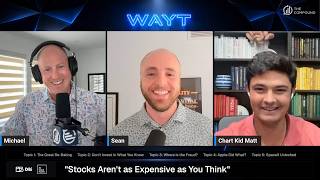
WAYT? 1-20-2026
Audio Brief
Show transcript
This episode explores the critical distinction between geopolitical noise and structural economic weakness while analyzing the defenses of the US bond market and the evolving competitive landscape for streaming giants.
There are three key takeaways from this conversation regarding market mechanics, capital flows, and investor psychology.
First, investors must learn to differentiate between geopolitical volatility and economic volatility. Geopolitical panic, driven by war threats or political headlines, should generally be viewed as noise that creates buying opportunities. This type of volatility is usually temporary. Conversely, economic volatility is far more dangerous because it signals that the profit-generating machinery of the market is broken. To gauge the true health of the economy, investors should ignore broad sentiment surveys and instead focus on specific banking data. Metrics like net charge-off rates at mass-market institutions serve as the most accurate proxy for the financial health of the average consumer.
Second, the persistent fear that foreign nations might weaponize US debt by dumping Treasuries is mechanically flawed. This narrative ignores the concept of There Is No Alternative. The US Treasury market is so massive that no other global market exists to absorb that volume of capital. If a major foreign holder were to sell aggressively, they would crash the value of their own reserves without finding a viable place to park the resulting cash. This creates a scenario of financial mutually assured destruction, making a debt dump an act of economic suicide rather than a strategic attack.
Third, winning a specific business sector often just graduates a company to a more difficult tier of competition. A prime example is Netflix, which has effectively defeated legacy media rivals like Disney. However, Netflix now faces a "Final Boss" competitor in Alphabet's YouTube. The battle has shifted from a competition over content libraries to a war for user attention. In this arena, the user-generated content model offers a cost structure and engagement loop that traditional production studios struggle to match.
Finally, transparency can be a strategic disadvantage in active management. The conversation highlights the "public figure penalty," noting that publicly defending a stock pick creates an ego trap. When an investor broadcasts a thesis, it becomes psychologically difficult to cut losses or pivot when the data changes. Anonymity allows for more rational decision-making because it removes the social pressure to stick with a losing trade.
Ultimately, success in the current environment requires ignoring headline noise in favor of hard banking data and recognizing that scale is the only true moat remaining in modern asset management.
Episode Overview
- Navigating Market Volatility vs. Noise: Explores the crucial distinction between "geopolitical noise" (which often presents buying opportunities) and "economic volatility" (which signals structural weakness), helping investors react more rationally to headlines.
- The Mechanics of Capital Wars: Analyzes the risk of trade disputes escalating into financial warfare, specifically debunking the fear of foreign nations "dumping" US debt by explaining the concept of "mutually assured destruction" in bond markets.
- Modern Business Strategy & Competition: Examines how companies like Netflix and BlackRock are facing new "Final Boss" competitors (like YouTube) and how scale has become the only true moat in asset management.
- Investor Psychology and Transparency: Discusses the "public figure penalty" in active management, arguing that anonymity is a strategic advantage because public scrutiny makes it psychologically harder to hold necessary contrarian positions.
Key Concepts
- Geopolitical vs. Economic Volatility: Investors should welcome geopolitical panic (war threats, tweets) as it is usually temporary noise that creates buying dips. Conversely, economic volatility (recession signals, consumer spending drops) is far more dangerous as it indicates the profit-generating machinery of the market is broken.
- The US Debt "Moat" (TINA Defense): The fear that China or Europe will dump US debt is mechanically flawed due to "There Is No Alternative" (TINA). The US Treasury market is so large ($27T+) that no other market exists to absorb that capital. Selling would crash the seller's own portfolio value, creating a "mutually assured destruction" scenario.
- "Source of Truth" in Economic Data: Broad sentiment surveys often mislead; the real economy is best viewed through specific banking data. Bank of America serves as a better "Main Street" proxy (average balance ~$9,000) than American Express. If charge-off rates here are low, the consumer is healthy regardless of headlines.
- The "Final Boss" of Competition: Winning a specific sector (like Netflix winning streaming against Disney+) often just graduates a company to a harder tier of competition. Netflix now fights the "Final Boss," YouTube/Alphabet, which competes for attention using a superior, lower-cost user-generated content model.
- Regulatory Arbitrage in Private Markets: As retail investors gain access to private equity through new "investable indices," these assets effectively lose their private status. This creates a regulatory arbitrage where firms access public-scale capital without public-scale disclosure burdens.
- The "Public Figure" Penalty: Transparency hurts investment performance. When investors must publicly defend losing positions (a necessary part of contrarian investing), the "ego trap" makes it psychologically harder to stay the course. Anonymity allows for rational pivoting without social ridicule.
- Vertical Software Moats: Unlike general apps, "vertical software" that runs an entire business (like ServiceTitan for plumbers) creates massive switching costs. Once a company's payroll, dispatch, and payments run on one OS, they almost never leave, creating a highly resilient business model even during tech sell-offs.
Quotes
- At 0:04:42 - "If there is going to be problems in the stock market... I don't want it to be from earnings. I don't want it to be from GDP or the consumer rolling over... Give me this noise all day... It subsides." - Michael Batnick explaining why geopolitical panic is actually the "best" kind of volatility for investors.
- At 0:05:59 - "When you have stocks that are 40-50% above their 200-day [moving average]... any reason for the volatility will make sense when you just watch stocks kind of give back insane gains." - Josh Brown highlighting how headlines often serve as convenient excuses for inevitable technical corrections.
- At 0:15:32 - "Even if Europe could force Europeans to sell, where would the money go? Sellers need buyers. And absorbing trillions of dollars of US assets would overwhelm any alternative market." - Josh Brown explaining the structural trap that prevents foreign nations from dumping US debt.
- At 0:20:35 - "I love listening to the financials reports because to me, they are my economic source of truth... I'm talking like Bank of America. That is right down the middle, average balance of $9,000. That is Main Street." - Michael Batnick identifying the specific data points that actually reflect the median consumer.
- At 0:26:35 - "You can't win that big if you're BlackRock without many people losing to you. The pie is not growing sufficiently that that money is just materializing out of thin air." - Josh Brown identifying that asset management is now a zero-sum game where giants eat the market share of smaller firms.
- At 0:29:40 - "Once you have indexes... and you have millions of people who become investors through these vehicles in these private markets, they're de facto no longer private. And then what it becomes is a regulatory arbitrage." - Josh Brown predicting the future friction between regulators and the 'democratization' of private equity.
- At 0:34:30 - "They beat a lot of the board-level mini-bosses, but now... it's Bowser... You have to fight Alphabet, bro. This is not Hulu." - Josh Brown explaining that Netflix's competition has shifted from entertainment studios to tech platforms that monopolize user attention.
- At 0:51:05 - "I don't care about this leadership trope... I still think the market could have a good year. People get bored of trades that stop working and look for trades that are working." - Josh Brown explaining that money rotating out of 'Mag 7' leaders into other sectors is a healthy sign, not a crash signal.
- At 0:56:36 - "You only think you want to be a contrarian because it sounds cool... Most people aren't built for it. They will never develop the degree of conviction needed to endure a contrarian trade that at first goes against them." - Josh Brown demystifying the romanticized view of 'The Big Short' style investing.
- At 0:58:08 - "When in doubt, just be quiet. If you're right, the market will reward you. You don't also need to get the crowd on your side while you're placing bets." - Josh Brown providing a rule for financial behavior to avoid the 'ego trap.'
- At 0:59:23 - "Rising prices attract buyers and falling prices attract sellers. And that is just permanent." - Michael Batnick summarizing the immutable nature of market psychology.
Takeaways
- Ignore the "Dump US Debt" Narrative: Do not base investment decisions on fears of China or other nations selling US Treasuries; the global financial structure makes this action an act of economic suicide for the seller.
- Monitor "Main Street" via Charge-Offs: Instead of reading broad economic sentiment news, watch the net charge-off rates of mass-market banks (like Bank of America). If these aren't spiking, the consumer is not in crisis.
- Buy the Geopolitical Dip: Train yourself to view political headlines and war scares as "noise" that creates buying opportunities, distinguishing them from actual economic data degradation.
- Practice Investment Silence: Avoid publicizing your specific stock picks or thesis. Publicly defending a trade locks you into a psychological "ego trap" that makes it harder to cut losses or pivot when the data changes.
- Look for "Rotation" not "Retraction": When market leaders (like Big Tech) falter, look for capital flow into neglected sectors (Energy, Financials) rather than assuming a total market crash is imminent.
- Identify "Final Boss" Competitors: When analyzing a company's moat, consider who they fight after they win their current sector. A company like Netflix looks strong against Disney, but weak against YouTube's infinite, low-cost content model.
- Bet on Vertical Software Integration: Look for software companies that run the "blue-collar" world (plumbing, HVAC, roofing). These industries are early in their digitization phase, and the "all-in-one" operating system nature of the software makes revenue incredibly sticky.