Trump Blasts FAKE POLLS As His Approval Rating PLUMMETS

Audio Brief
Show transcript
This episode covers the final stretch of the midterm elections, examining a fracturing Republican coalition, fabricated polling operations, administration corruption scandals, and the high-stakes Georgia governor's race.
There are four key takeaways from this conversation. First, eroding support among working-class voters is forcing Republicans to spend defensively in traditionally safe red states. Second, fabricated polling operations have successfully infiltrated major aggregators, manipulating media narratives and primary campaigns. Third, newly uncovered influence-peddling schemes and aggressive campaign tactics are creating significant political liabilities for the GOP. Fourth, the Georgia gubernatorial race highlights how strong local track records and voter mobilization can counter massive financial disadvantages.
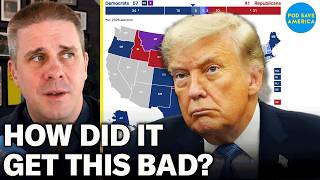
On the shifting electoral map, the final New York Times and Siena poll shows Democrats leading the generic ballot by 11 points, while Donald Trump's approval rating sits at 36 percent. This shift is driven by cracks in the MAGA coalition, with Trump's approval among white working-class voters without a college degree dropping to 51 percent, down from 66 percent support in 2024. Despite low overall satisfaction with the Democratic Party, voters now trust Democrats more on every major issue, including immigration and working-class economics. Consequently, Republicans are pouring late defensive money into deep-red Senate races in Kansas, South Carolina, and Mississippi, where narrow polling leads and high Black voter shares make long-shot Democratic victories mathematically viable.
Regarding polling integrity, data analysts at 50 plus 1 recently exposed a fake polling firm called Wedgwood Polls that fabricated numbers to manipulate election narratives. Along with suspicious operations like SoCal Strategies and Noor Media, Wedgwood lied on vetting questionnaires to get included in major polling aggregators. While these firms produced overly favorable general election numbers for some liberals, the hosts note that a fabricated Wedgwood poll in the Michigan Senate primary actively damaged candidate Mallory McMorrow, triggering a fundraising and narrative death spiral that forced her out of the race.
Meanwhile, Republicans face mounting scrutiny over administration scandals, foreign policy risks, and extreme campaign tactics. New reporting indicates the Pentagon and Israel are planning post-midterm military strikes against Iranian nuclear facilities. Domestically, the Justice Department is investigating former Trump advisor Corey Lewandowski for trading Department of Homeland Security contracts for consulting fees, while former DOJ official Alina Habba reportedly secured a 50 million dollar sham legal contract from a Venezuelan billionaire just weeks before Trump pardoned him. On the campaign trail, Ohio Republican Vivek Ramaswamy is facing bipartisan backlash for a four million dollar attack ad featuring the estranged mother of Democratic opponent Amy Acton, who abandoned Acton decades ago after her second husband was charged with abusing the candidate as a child.
Finally, in Georgia, Democratic gubernatorial nominee Keisha Lance Bottoms is battling an opponent who has spent 200 million dollars on the race, including 100 million dollars directly attacking her. Despite this massive spending gap, an Atlanta Journal-Constitution poll shows the race tied and Bottoms winning independents. She is focusing her campaign on Medicaid expansion, updating the state's 1985 education funding formula, and scrutinizing her opponent's financial conflicts of interest in Georgia's booming data center industry. However, voters still face severe election administration hurdles, including extreme heat and strict state laws criminalizing the distribution of water to people waiting in polling lines.
Ultimately, as the midterm cycle concludes, the outcomes in both traditional battlegrounds and unexpected red states will hinge on whether Democrats can convert working-class dissatisfaction into actual turnout among young and low-propensity voters.
Episode Overview
- Hosts Jon Favreau, Dan Pfeiffer, and Jon Lovett analyze the final stretch of the midterm elections, examining how a fracturing MAGA coalition and shifting polling averages are forcing Republicans to play defense in traditionally safe red states.
- The discussion exposes a network of fabricated polling operations that manipulated media narratives and primary races, alongside reports of Pentagon plans for post-midterm military strikes against Iran.
- The hosts break down high-profile campaign controversies and debates in Ohio, Michigan, and Kansas, as well as newly reported influence-peddling and corruption scandals within the Trump administration.
- Former Atlanta Mayor and Democratic gubernatorial nominee Keisha Lance Bottoms joins the show to discuss the high stakes of the Georgia governor's race, overcoming massive campaign spending against her, and her policy vision for the state.
Key Concepts
- Shifting Electoral Coalitions and Defensive Spending: The final New York Times/Siena poll of the cycle shows Democrats leading the national House vote among likely voters by 11 points (52% to 41%) and Donald Trump's approval rating at 36% (down 3 or 4 points since September). The Silver Bulletin average places the generic ballot at 9 to 10 points, with Democratic Senate candidates leading by roughly 1 point in Iowa and Kansas, 2.5 points in Texas, 3 points in Maine and Michigan, and 4 points in Ohio and Alaska—though Favreau caveats that these leads are close enough that an ordinary polling error could still wipe them out. This environment is driven by cracks in the original MAGA coalition: while 2024 exit polls showed Trump winning white working-class voters without a college degree with 66% of the vote, his approval among them in the new NYT/Siena poll is down to 51%, with strong approval at 34%. Although only 28% of respondents are satisfied with the Democratic Party—and Pfeiffer hedges that this does not solve all the party's problems or guarantee success in 2028—Democrats now lead by double digits on being seen as the party of the working class and are more trusted on every issue, including immigration. Consequently, Trump's Super PAC is reportedly putting another $25 million into House races, and Republicans are pouring money into Kansas and South Carolina while weighing a last-minute investment in Mississippi. Pfeiffer notes that while winning 6-year Senate terms in these states are long shots, they are not a fool's errand: Mississippi has the largest or second-largest share of Black voters (who back Democrats at north of 85%), and in South Carolina, if third-party candidates take 3% to 5% of the vote, Democrat Annie Andrews only needs 47.5% to win—just 3 to 3.5 points better than Jaime Harrison's 43.8% (or 44%) in the 50/50 year of 2020.
- Turnout Filtering and Candidate Name Recognition: Polling outcomes heavily depend on turnout models. In the NYT/Siena poll, the 11-point Democratic generic ballot lead expands to 14 points when filtered by voters who say they will vote, but drops to 9 points when filtered by predicted likelihood based on past voting history and identity. Pfeiffer notes there is very early evidence of young, low-propensity voters turning out, though he caveats it is way too early to know for sure. In Kansas, which hasn't elected a Democratic Senator in 94 years (since Herbert Hoover was president), candidate Adam Hamilton—who leads a 100,000-member church and attacked Sen. Roger Marshall (who Pfeiffer claims once ordered the arrest of a woman who owed him $50) in a recent debate—has lower name ID and is currently underperforming the generic ballot among undecideds who pick Democrats, though Pfeiffer caveats this is based on a small sample size.
- The Mechanics and Impact of Fake Polling: The data site 50+1, run by G. Elliott Morris (formerly of 538 and author of the Substack Strength in Numbers), uncovered a fake polling firm called Wedgwood Polls by rerunning a suspicious poll on the same platform to prove the numbers were fabricated. Once caught, Wedgwood claimed it was an "experimental project." Nate Silver's analysis noted that Wedgwood produced some of the most favorable polls for liberal candidates like Troy Jackson, Abdul El-Sayed, and Francesca Hong (showing Hong beating Tom Tiffany by 3 points), and polled Mississippi early on. The hosts also identify two other suspicious operations: SoCal Strategies and Noor Media (or Noor Media Strategies, which released a fake Los Angeles poll showing Karen Bass leading Nithya Raman by a wide margin). This mirrors 2010s fake polling firms Strategic Vision and Research 2000, which tricked newspapers into paying for fabricated polls. While FCC Chairman Brendan Carr threatened the licenses of broadcasters airing fake polls, Wedgwood successfully lied on vetting questionnaires to get included in major aggregators like the New York Times. Pfeiffer—who discloses that he supported Mallory McMorrow in the Michigan primary and considers her a friend—argues that while structural challenges existed in the three-way race and he isn't saying she would have won otherwise, the fake poll damaged her campaign and triggered a fundraising and narrative death spiral.
- Post-Midterm Foreign Policy Risks: According to a New York Times report, the Pentagon is working with Israel on detailed plans to launch a new military operation against Iran immediately after the midterms, operating on the theory that a few days of intense bombing could push Iran's economy over the brink. Defense Secretary Pete Hegseth met with Israeli Prime Minister Bibi Netanyahu (who faces elections this coming Tuesday) this week, and reports indicate they are considering dropping the "Mother of All Bombs" on Pickaxe Mountain, a deeply buried nuclear facility, though Trump has not yet approved the plans.
- Campaign Backlash in the Ohio Governor's Race: In Ohio, Republican Vivek Ramaswamy put $4 million behind an attack ad featuring the estranged mother of Democratic opponent Amy Acton calling her daughter a liar and unfit for office. Acton and her brother had been removed from their mother's custody after her mother's second husband—who had previously been indicted for sexually abusing his own daughter from another marriage—was charged with raping Amy when she was 10 or 12 years old. The husband fled the state to avoid trial with Acton's mother, who stayed married to him until his death and has had no involvement in Acton's life for 50 years. While Gov. Mike DeWine, Sen. Jon Husted, former Sen. Rob Portman, and former Rep. Jim Renacci denounced the ad, JD Vance, Donald Trump (who called it "hitting paydirt"), and right-wing media figures like Ben Shapiro (as reported by Will Sommer at The Bulwark) defended it. Pfeiffer hedges that there is no post-ad polling yet and it may remain an object of fascination for the politically obsessive rather than turning the election, but argues it will not help a candidate whose primary vulnerability is his unlikability.
- Administration Corruption and Pardon Schemes: Multiple reports highlight influence-peddling within the Trump administration. Following an earlier story involving former Trump personal attorney and former US Attorney for New Jersey Alina Habba, her Turkish billionaire husband, the Kennedy Center, and the Democratic Republic of Congo, a New York Times report revealed that Venezuelan billionaire Julio Herrera Velutini sought to expunge a campaign finance misdemeanor conviction. After a massive Trump Super PAC donation failed to secure it, he created a fake business and hired Habba as its fake general counsel while she was still at the DOJ (operating as a Special Government Employee, which allows working for 130 days while earning outside income), promising her $50 million over 4 years (with Pfeiffer estimating she has received $10 million so far); weeks later, Trump granted Herrera a full and unconditional pardon. Separately, the Wall Street Journal reported that the DOJ is investigating whether former Trump campaign manager Corey Lewandowski profited off his role as a senior advisor and romantic partner to Kristi Noem at DHS by approving contracts for clients of his consulting firm; Lewandowski told friends he expects a pardon if charged. Additionally, DHS reportedly overpaid for a private plane linked to Noem's political supporters featuring bedrooms, showers, marble countertops, and a table made of manta ray skin (from animals often 8 feet wingtip-to-wingtip). When Sen. Elissa Slotkin told Astead Herndon at the IOP in Chicago that Democrats must pursue accountability on signature corruption cases, Republicans Mike Davis, Mike Lee, and Steve Scalise reacted with outrage.
- The Stakes of the Georgia Governor's Race: Democratic nominee Keisha Lance Bottoms (soliciting support at
keishaforgovernor.com), who left the Atlanta Mayor's office in 2021 with a 68% approval rating after turning down an offer to run the SBA and being on Biden's VP shortlist, explains why executive power in Georgia is vital. The Governor makes 4,000 appointments to boards and commissions, controls the budget, can suspend the gas tax, and oversees a state with a 6-week abortion ban, an education funding formula written in 1985, and one of only 10 state governments that has not expanded Medicaid. Georgia is also #1 in the nation for new data center construction—surpassing Northern Virginia with billions in promised incentives—and Bottoms notes her opponent, Rick Jackson, owns and invests in four data center companies and once extended a loan to a failing Alabama hospital at a 14% to 19% interest rate. Despite Jackson putting $200 million into the election ($100 million against Bottoms alone, sending her household 3 duplicate mailers a day), an Atlanta Journal-Constitution poll released the day of recording shows Bottoms winning independents and tied overall, building on a May primary where Democrats were outspent by $100 million yet outvoted Republicans by 150,000 votes. She also highlights ongoing voting rights battles, noting that 260 FBI agents have currently been dispatched to Fulton County to investigate the 2020 election (where Trump famously asked to find 11,000 votes), and that voters recently stood in line in 85-degree heat under a state law that makes handing someone in line a bottle of water a criminal offense punishable by jail time. - Disclosed Sponsors and Business Ties: Throughout the episode, the hosts disclose funding from their subscription service "Friends of the Pod" (
crooked.com/friends), which supports Crooked Media and their legal defense fund, as well as commercial partnerships: SimpliSafe Home Security (simplisafe.com/crooked, trusted by over 6 million people with agents intervening in under 30 seconds and 60% off with professional monitoring; Favreau discloses Crooked Media's CEO recently got a system); ActBlue (actblue.com/crooked, empowering campaigns for over 2 decades and helping over 350,000 volunteers across 50 states); Willie's Remedy+ (drinkwillies.com, code CROOKED for 20% off a first order and free shipping over $95, featuring 15 calories, 3g of sugar in 5mg and 10mg doses, with over 350,000 customers and 1 million+ bottles sold; endorsed by Favreau and Pfeiffer as personal users); Vanta (vanta.com/crooked, offering 400+ integrations, automating compliance for 35+ frameworks, paying for itself in 3 months with a 526% ROI over 3 years); Quince (quince.com/crooked, offering cashmere sweaters from $60, priced 50% to 80% less than similar brands with 365-day returns; Favreau discloses owning several items); and Nutrafol (nutrafol.com, code CROOKED for 20% off subscriptions and $15 off the first month, showing results in 3 to 6 months; Lovett discloses taking it daily with breakfast).
Quotes
- At 0:03:34 - "The final New York Times/Siena poll of the cycle came out Wednesday, yesterday, has Dems leading the national House vote among likely voters by 11 points, 52 to 41, with Donald Trump's approval rating at just 36%." - Jon Favreau establishing the baseline polling environment heading into the final days before the midterm elections.
- At 0:04:34 - "'The wall has broken, the enemy is inside the fort, we are now fighting hand to hand.'" - Jon Favreau quoting a Republican strategist in Axios on why the GOP is suddenly pouring defensive money into deep-red states like Kansas, South Carolina, and Mississippi.
- At 0:05:30 - "We seriously looked at the Atlantic Ocean and I called Google Maps, who were really great with the lake and really great, we're going to call it the American Ocean." - Donald Trump, via a rally clip, delivering his closing midterm argument in South Carolina.
- At 0:08:16 - "What is changing is that the original MAGA coalition itself is beginning to break apart." - Dan Pfeiffer explaining the significance of Trump's approval dropping to 51% (and strong approval to 34%) among white working-class voters without a college degree.
- At 0:09:04 - "The Democrats are now more trusted than Republicans on every issue, including immigration, and now are seen as the party of the working class, the party that understands problems faced by people like you, the party that can fix problems faced—the problems faced by people like you, by double digits." - Dan Pfeiffer highlighting internal metrics from the New York Times/Siena poll despite overall satisfaction with the Democratic Party sitting at 28%.
- At 0:21:32 - "However, there's no question that this fake poll damaged her campaign and kind of kicked off a death spiral that forced her to leave the race." - Dan Pfeiffer discussing how fabricated numbers from Wedgwood Polls impacted Mallory McMorrow's Senate primary campaign in Michigan.
- At 0:27:09 - "When you got a bunch of dumb hammers at the Pentagon, everything looks like a nail." - Dan Pfeiffer reacting to New York Times reporting that the Pentagon and Israel are planning a post-midterm bombing campaign against Iran.
- At 0:34:41 - "And now the media and the Democrats in the state of Ohio are obsessed because guess what? Vivek Ramaswamy had the audacity to run a TV commercial which calls it out like it is and calls Amy Acton a liar." - JD Vance, via a rally clip, defending Ramaswamy's $4 million attack ad featuring Acton's estranged mother.
- At 0:36:25 - "An ad this disgusting, that accuses a 12-year-old of lying about rape, that even members of your own party, popular members of your own party, are saying is disgusting, is not going to help the candidate whose biggest vulnerability is that everyone thinks he's an asshole." - Dan Pfeiffer analyzing the political fallout of Vivek Ramaswamy's attack ad in the Ohio governor's race.
- At 0:45:43 - "To bring into question my commitment to the Constitution is really beneath you. I am proud of America. I'm proud to be an American. I'm proud of our Constitution that guarantees all of us the right to pray as we choose to pray." - Abdul El-Sayed, via a debate clip, responding to attacks on his faith during the Michigan Senate debate.
- At 0:49:43 - "You say you've listened at 300 campaign stops. You did not listen at 300 campaign stops. You had 300 photo ops." - Democratic candidate Adam Hamilton, via a debate clip, confronting Republican Sen. Roger Marshall in the Kansas Senate debate.
- At 0:54:03 - "Trump was asked about all this just before we recorded, and said that if his people aren't honest, they have to be prosecuted because, 'They're stealing from me,' is what he said." - Jon Favreau recounting Trump's reaction to influence-peddling and corruption allegations against Alina Habba and Corey Lewandowski.
- At 1:15:35 - "This much money has never been spent to try and slander one person, one family, than has been put up against my family and I. And we are still tied in this race." - Keisha Lance Bottoms discussing the $100 million spent directly against her by opponent Rick Jackson in the Georgia governor's race.
- At 1:25:34 - "When this guy says he wants to be Trump's favorite governor, like, I want to be the favorite governor of that little girl who no longer gets to go to ballet, but has to go visit her dad in prisons on the weekends." - Keisha Lance Bottoms contrasting her motivation for running for Governor of Georgia—rooted in her own experience of her father going to prison when she was 8—with her opponent's platform.
Takeaways
- Track late-stage campaign expenditures and candidate travel schedules (such as Super PACs defending Kansas, South Carolina, and Mississippi) rather than relying solely on individual polls to gauge which races are genuinely competitive.
- Verify the provenance and methodology of unfamiliar polling firms before trusting their data, especially in primary elections where bad actors like Wedgwood Polls, SoCal Strategies, and Noor Media can fabricate crosstabs to manipulate media narratives and donor behavior.
- Evaluate polling averages by examining the gap between self-reported likely voters and past-history voter models, recognizing that the ultimate margin of victory depends on mobilizing young, low-propensity, and Black voters during early voting and on Election Day.
- Capitalize on fractures within the opposing coalition by focusing campaign messaging on working-class economic issues and cost-of-living solutions where voters are actively re-evaluating party trust.
- Avoid deploying deeply personal, unvetted character attacks that alienate moderate voters and draw condemnation from within your own party, as exemplified by the bipartisan backlash against Vivek Ramaswamy's ad in Ohio.
- Frame oversight of executive branch corruption around clear, high-profile examples of self-enrichment—such as pardons linked to fake consulting contracts or lavish taxpayer-funded purchases—to make accountability tangible to the public.
- Counter massive financial disadvantages in statewide races by contrasting a proven local executive record (such as balancing budgets, raising wages to $15/hour, and building affordable housing) against an opponent's corporate conflicts of interest, such as data center investments and high-interest hospital loans.
- Prepare voters for election administration hurdles—such as long lines, heat, and strict state voting laws like Georgia's ban on handing out water—to ensure high turnout despite systemic friction.