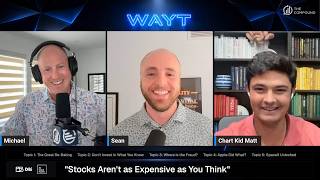
Quality in the Streets, Momentum in the Sheets | TCAF 217
Audio Brief
Show transcript
This episode covers a significant market shift, analyzing the recent unraveling of dominant AI and momentum trades, the implications of extreme market concentration, and the value of rules-based investing.
There are three key takeaways from this discussion.
First, the market is experiencing an unraveling of the AI and momentum trades that have primarily driven returns in the Magnificent Seven stocks. Historic divergence between cap-weighted and equal-weighted indices highlights extreme market concentration, raising debate whether this is a structural flaw from passive investing or a rational outcome of company fundamentals. This shift suggests a potential broadening of market leadership beyond mega-cap tech.
Second, a persistent bearish sentiment among investors contrasts sharply with strong market fundamentals, including robust earnings and easing Federal Reserve policy. Many market commentators maintain skepticism, often shifting their rationales when initial concerns do not materialize. This widespread doubt and lack of euphoria are viewed as a bullish contrarian indicator for future market performance.
Third, the discussion strongly advocates for rules-based, systematic investment strategies to overcome common emotional biases. Discretionary trading often leads investors to miss significant opportunities or sell winning positions too early. Implementing disciplined, non-discretionary processes is becoming increasingly critical in today's complex and often emotionally charged equity market.
In conclusion, navigating current market dynamics requires acknowledging shifting leadership, leveraging contrarian signals from sentiment, and adopting disciplined, rules-based investment approaches.
Episode Overview
- The hosts discuss a significant market shift, analyzing the recent unraveling of the dominant AI and momentum trades that have driven returns, particularly in the "Magnificent Seven" stocks.
- The conversation delves into the causes and implications of extreme market concentration, debating whether it's a structural flaw caused by passive investing or a rational outcome based on company fundamentals.
- A key theme is the disconnect between strong market fundamentals (earnings, Fed policy) and persistently bearish sentiment among investors, which the panel views as a bullish contrarian indicator.
- The discussion concludes with a strong advocacy for rules-based, systematic investment strategies as a way to overcome emotional biases and navigate a market where discretionary trading is becoming increasingly difficult.
Key Concepts
- Unraveling Momentum Trade: The primary driver of the market for the past year—the AI and momentum factor—is showing signs of weakness, with "good news, bad price action" for leading tech stocks.
- Extreme Market Concentration: An historic divergence between the cap-weighted S&P 500 and the equal-weighted version highlights how a few mega-cap stocks are responsible for the majority of market gains.
- Passive Investing Debate: A central argument explores whether the massive inflows into market-cap-weighted index funds are creating a feedback loop that distorts valuations, or if the concentration is a rational reflection of the Magnificent Seven's dominance.
- Persistent Bearish Sentiment: Despite positive fundamentals like strong earnings, easing Fed policy, and low bond market volatility, the prevailing mood among many market commentators remains one of doubt and disbelief.
- Investor Psychology: The discussion covers the "pain trade" for underweight portfolio managers, the tendency for successful older investors to become more bearish as they have more to lose, and the shifting rationales for skepticism.
- Rules-Based vs. Discretionary Strategy: A case is made for systematic, non-discretionary investing to remove human emotion, which can lead traders to miss opportunities or sell winners too early.
- Broadening Market: Despite turmoil in mega-cap tech, there are signs of a healthy rotation into previously overlooked sectors such as financials, healthcare, and energy.
Quotes
- At 2:55 - "I think the biggest thing that's changed in the market over the last, let's say 10 days to two weeks is... there's a lot of doubt about some of the biggest winners of the bull market... The AI capex story is now fully under the microscope." - Josh Brown sets up the segment's core topic, highlighting the sudden skepticism surrounding the market's primary narrative.
- At 8:02 - "Last week, the cap-weighted index, SPY, outperformed the equal weight, RSP, by 3.6%... over a four-day period, that has only happened two other times... It happened in October 2008 and it happened in June 2020." - Michael Batnick provides a stunning statistic to illustrate the extreme divergence between the mega-cap tech stocks and the rest of the market.
- At 12:45 - "The villain in all of this is what? It's passive investing... It's not a market that I would describe as efficient because you're forcing capital into seven stocks." - Joe Terranova argues that the massive flows into market-cap-weighted index funds create a dangerous feedback loop.
- At 15:53 - "If I'm a portfolio manager and I underweight Apple, and the stock is up 50% year to date, I probably don't have a job... So part of this is a rational response to who the best players on the court are." - Josh Brown offers a counterpoint, suggesting career risk makes concentration a logical outcome.
- At 25:50 - "I love the conditions right now. I think the conversation that we're having is so consensus on any show. It's a lot of doubt, it's a lot of disbelief." - Michael Batnick expresses bullishness, arguing that widespread skepticism is a positive sign for the market.
- At 26:37 - "The reasons for that doubt keep shifting... People that were skeptical six months ago were skeptical for reason A. Reason A turned out not to matter that much. So then they shift to reason B, but they remain skeptical." - Josh Brown observes that bearish narratives constantly change, indicating a persistent psychological bias.
- At 29:33 - "The pain trade is not for the market to fall 10%. The pain trade is for the Magnificent Seven to go up another 20%... because everybody is either short or underweight..." - Michael Batnick articulates the psychological trap for professional investors.
- At 32:06 - "You can't tell somebody what not to compare you to… they're going to default to the big five stocks that they know really well and probably own, and they're going to default to the S&P." - Josh Brown explains the challenge for financial advisors when clients benchmark diversified portfolios against a concentrated index.
- At 42:33 - "I think rules-based strategies are really critical for all of you over the next several years. I think that discretionary strategies in the equity world, boy, they're going to have a really, really tough time." - Joe Terranova advocates for systematic, rules-based investing as a superior approach.
- At 50:06 - "I am telling you, 100%, I would have sold the stock if I had discretion six times over... The strategy, the discipline, the rules, goes in and buys Nvidia. That's the benefit of a rules-based strategy. Removes the human emotion." - Joe Terranova uses a concrete example to illustrate how a rules-based system overcomes emotional trading errors.
Takeaways
- Implement a rules-based, disciplined investment process to remove emotional decision-making, which can prevent you from chasing performance or selling winning positions prematurely.
- Avoid using the hyper-concentrated S&P 500 as the sole performance benchmark for a properly diversified portfolio, as its returns are dominated by a handful of stocks.
- Be aware of your own psychological biases, such as the tendency to become overly bearish or risk-averse after periods of success, which can hinder long-term growth.
- View widespread market doubt and a lack of euphoria not as a reason to sell, but as a potentially bullish sign that the market has room to run higher.
- Re-evaluate heavy exposure to the most crowded momentum stocks and consider looking for opportunities in overlooked sectors like energy, healthcare, and financials as market leadership begins to broaden.
- Recognize that short-term pessimism is common, but maintaining a long-term optimistic perspective is historically the winning strategy for equity investors.