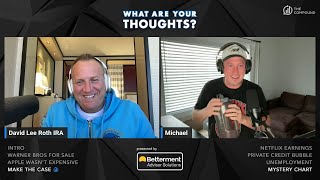
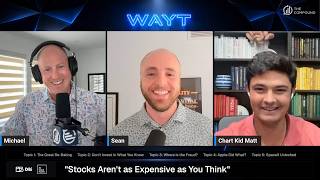
Pre-Crisis Vibes All Over the Stock Market | WAYT?
Audio Brief
Show transcript
Episode Overview
- This episode analyzes the disconnect between record corporate earnings and stagnant stock prices, explaining why "good news" isn't lifting the market.
- It explores a major structural shift in the tech sector, moving from "asset-light" software dominance to a capital-intensive "AI arms race" that is depressing valuations.
- The hosts discuss the "HALO" trade (High Asset, Low Obsolescence), arguing that physical industries are becoming the new defensive play against AI disruption.
- A critical warning is issued regarding private credit and private equity markets, where artificial valuations may be hiding significant losses that public markets have already priced in.
- The discussion provides a framework for understanding how AI will impact wages, distinguishing between jobs where AI lowers barriers to entry (bad for wages) versus automating drudgery (good for wages).
Key Concepts
-
P/E Multiple Compression: This occurs when corporate earnings grow, but stock prices stay flat or decline, resulting in a lower Price-to-Earnings ratio. This is currently happening because investors are less confident in future cash flows due to AI uncertainty, leading them to pay less for every dollar of earnings today.
-
The Shift to "Asset Intensity": For over a decade, tech companies were valued highly for being "asset-light" (generating profits with low costs). The AI boom has reversed this; giants like Meta and Amazon are now pouring massive capital into infrastructure (CapEx). This shift to capital-intensive models justifies lower valuation multiples compared to the previous era of high-margin software.
-
Disruption Math & Value Traps: Historically, when a sector faces technological disruption, "cheap" valuations are a trap. When AI threatens incumbent software models, those companies trade at low valuations because their future earnings are genuinely at risk. Investors often mistake these declining companies for bargains, not realizing they are "lagging rather than leading."
-
The "HALO" Trade: This stands for High Asset, Low Obsolescence. It represents a rotation of capital into companies with significant physical assets (e.g., Deere, Caterpillar, Waste Management). The thesis is that while AI can disrupt code and digital work, it cannot easily replace physical tasks like digging holes or moving trash, making these industries the new defensive assets.
-
The "Hard Parts" Theory of AI Displacement: To predict if AI will destroy a job's wages, ask if it automates the "hard part" or the "easy part."
- Taxi Driver Model: If tech automates the hard skill (navigation), barriers to entry fall, labor supply spikes, and wages crash.
- Accountant Model: If tech automates the drudgery (calculations), professionals focus on high-judgment tasks, specialization increases, and wages rise.
-
GAAP vs. Non-GAAP Reality Check: Many software companies report healthy "Non-GAAP" margins by excluding Stock-Based Compensation (SBC). However, in a high-interest-rate environment, investors are scrutinizing "real" (GAAP) profitability. This reveals that many "profitable" tech firms are actually losing money once shareholder dilution from SBC is accounted for.
-
Private Market "Volatility Laundering": There is a dangerous disconnect between public and private valuations. Publicly traded assets in sectors like housing and credit have dropped 40-60%, while private equity firms have not marked down their private assets to reflect this reality ("mark-to-model" vs. "mark-to-market"). This creates a false sense of stability that may eventually force a painful correction.
Quotes
- At 0:03:30 - "The only answer I can give you is that investors are less confident in future cash flows and are therefore demonstrating a lack of willingness to pay current multiples." - Explaining why the market might lag even when earnings are hitting record highs.
- At 0:04:16 - "Valuations are not a catalyst, they're not support... there's no floor." - Clarifying that just because a stock is 'cheap' by historical standards does not mean it cannot go lower.
- At 0:11:50 - "Did you know Ford is now more profitable than Amazon, Meta, and Alphabet? ... Those three stocks are putting over 100% of their operating cash flow back into CapEx this year." - Highlighting the massive shift in capital efficiency occurring in Big Tech due to the AI arms race.
- At 0:14:40 - "Stocks do bottom on bad news." - Explaining that market bottoms usually occur when news is terrible, suggesting that negative earnings revisions could paradoxically signal a buying opportunity.
- At 0:21:05 - "The gap is massive and persistent. The spread between GAAP and non-GAAP operating margin has consistently been around 20 percentage points, almost entirely driven by stock-based compensation." - Highlighting the accounting "magic" used by tech companies to appear profitable.
- At 0:31:05 - "This is a rerating. This is the market saying, 'We're not paying 10 times sales for 18% growth anymore.' That's over." - A definitive statement on the regime change in software investing; the days of paying infinite multiples for moderate growth are ending.
- At 0:38:00 - "Technology enters a job and removes certain tasks while leaving others intact. What happens next... depends on whether the hard parts were taken away or the easy parts." - The core framework for understanding AI disruption and its effect on wages.
- At 0:45:34 - "Scarcity of heavy assets... real yields, geopolitical fragmentation, and supply chain reshoring have shifted the focus toward tangible productive assets." - Explaining the macroeconomic tailwinds supporting the shift from digital assets back to physical infrastructure.
- At 0:54:19 - "Not content with the market that they have... they want to make them bigger by finding new outlets of capital. What are they going to? Retail. Consumers. 401ks. Insurance companies." - Warning that risky private credit assets are being offloaded onto retail investors.
- At 0:55:39 - "In a financial crisis, a trader would say 'I think an investment is worth X' and I'd say 'Go out and sell it' and they couldn't... We don't know what something is worth for sure unless you try to sell it." - Highlighting the danger of illiquid assets; spreadsheet values are often illusions compared to market prices.
- At 0:57:50 - "If the publicly traded stocks are down 60%, what do you think the privately traded businesses are worth as a percentage of what they were worth? Way less... Investors aren't waiting." - Explaining why stocks of private credit managers are crashing; the market is pricing in the write-downs that private equity firms haven't admitted to yet.
- At 1:12:20 - "Everybody knows that there is risk, okay? What do you think a stock down 40% is telling you? That everything's great? Oh, that's risky? No sht." - Emphasizing that the stock market is a forward-looking discounting mechanism that has already identified the rot in these sectors.*
Takeaways
- Scrutinize "Cheap" Tech Stocks: Do not buy software stocks simply because they have fallen significantly from their highs. The valuation reset (e.g., from 10x sales to 5x sales) is likely structural due to AI risks, not a temporary dip.
- Invest in "Physical Moats": Consider shifting portfolio allocation toward the "HALO" trade (industrials, waste management, infrastructure). These physical asset businesses are currently more defensible against AI disruption than pure digital businesses.
- Ignore Non-GAAP "Profitability": When analyzing tech companies, look immediately at GAAP margins. If a company is only profitable by excluding Stock-Based Compensation, treat it as a loss-making entity in the current high-interest rate environment.
- Beware of Private Credit in Retail Accounts: Be extremely cautious of investment products (like certain ETFs or 401k options) that offer exposure to private credit or private equity. The stated values of these assets may be artificially high compared to their true market value.
- Monitor the "Hard Parts" of Your Industry: Assess your own career or business through the lens of AI disruption. If technology is lowering the barrier to entry for your core skill (making the "hard part" easy), you face wage deflation. If it automates your admin work, you face wage growth.
- Watch Public Managers for Private Signals: Use the stock performance of public asset managers (like Blackstone or Blue Owl) as a leading indicator for the true health of private markets. If their stocks are crashing, the private assets they manage are likely in trouble.
- Prepare for "Good Earnings, Bad Stock" Scenarios: Mentally prepare for periods where your portfolio holdings report record earnings but the stock price drops. This is a rational market pricing in future uncertainty; do not panic sell solely because price action disconnects from current results.