OpenAI’s Risky Browser Bet, Amazon’s Mass Automation Plan, Clippy’s Back

Audio Brief
Show transcript
This episode covers the dual nature of advanced AI agents, contrasting their potential with significant security hurdles, long-term economic shifts, and the subtle ways corporations discuss automation.
There are four key takeaways from this discussion. First, agentic AI, exemplified by OpenAI's Atlas, faces severe trust and security challenges despite its capabilities. Second, the true impact of AI agents on work will unfold over a "decade of the agent," gradually reducing new job creation rather than causing sudden mass layoffs. Third, mass automation presents an economic paradox, as increased efficiency risks eroding the consumer base necessary for sustained growth. Fourth, corporations often use strategic language, like "advanced technology" instead of "AI," to manage public perception of their automation efforts.
OpenAI's Atlas browser demonstrates AI agents performing complex tasks such as booking flights and data scraping on a user's behalf. However, integrating these agents into daily life demands unprecedented levels of trust to handle sensitive personal and financial data. Current technology and user confidence are not yet ready for such deep integration, posing a fundamental barrier to widespread adoption.
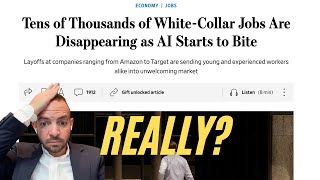
Experts suggest we are in the "decade of the agent," implying a gradual, 10-year timeline for significant societal integration rather than an overnight revolution. Companies like Amazon are focusing on automating future tasks and reducing new hires through robotics and AI. This shift means long-term job displacement, where the economy grows but with fewer human workers over time, rather than immediate, widespread job losses.
The increasing efficiency gained through mass automation creates a critical economic dilemma. If automation significantly reduces the number of employed consumers, it undermines the purchasing power essential for a consumer-driven economy. This paradox questions how companies can sustain growth if they ultimately diminish their own customer base.
Corporations are strategically employing carefully chosen terminology to describe their automation initiatives. Terms like "cobots" or "advanced technology" are used to replace "robots" or "AI," softening the public perception of job automation. Understanding this linguistic shift is crucial for accurately assessing the real impact of these technological changes.
This episode underscores the complex interplay between technological advancement, economic reality, and societal adaptation in the age of AI agents.
Episode Overview
- The hosts review OpenAI's new AI-first browser, "Atlas," which features agentic capabilities that can perform actions on a user's behalf, but raise significant security and trust concerns.
- The conversation contrasts AI hype with reality, adopting Andrej Karpathy's view that we are in the "decade of the agent," suggesting a 10-year timeline for significant societal change.
- The discussion explores the real-world impact of automation on the workforce, using Amazon's plan to replace future hiring with robotics and OpenAI's project to automate junior banking roles as key examples.
- A central theme is the "automation paradox," questioning how a consumer economy can function if mass automation reduces the number of employed consumers.
Key Concepts
- Agentic AI Browser: OpenAI's "Atlas" browser moves beyond information retrieval, featuring an AI agent that can perform complex actions like booking flights, creating playlists, and scraping data on the user's behalf.
- Security and Trust Barriers: A major hurdle for agentic AI is user trust, as giving an autonomous agent access to sensitive personal and financial information presents significant security risks.
- The Decade of the Agent: The true integration of AI agents into daily life and work is projected to be a gradual, decade-long process, not an overnight revolution, due to technological and organizational unpreparedness.
- Automation vs. Job Replacement: Large companies may not fire current employees but will automate tasks to drastically reduce future hiring, leading to long-term job displacement as the economy grows.
- Corporate PR and Automation: Companies are strategically using language, such as "cobots" instead of "robots" and "advanced technology" instead of "AI," to soften the public perception of their automation efforts.
- The Automation Paradox: Mass automation creates an economic dilemma where companies that eliminate jobs to increase efficiency risk destroying the consumer base that purchases their goods and services.
Quotes
- At 1:54 - "Few have succeeded. And by few, I mean none have succeeded." - Alex Kantrowitz emphasizing the historical difficulty of launching a successful new web browser against established players.
- At 25:22 - "I had not logged into anything sensitive when I was playing with Atlas. I was only having it just like... even logging into Reddit, I was a little nervous around." - Ranjan Roy elaborating on his security concerns and distrust of giving an AI agent access to his accounts.
- At 25:59 - "It's not the year of the agent, it's the decade of the agent, and the technology today is just not ready to sort of take that mantle, and it's going to take about 10 years." - The host summarizing Andrej Karpathy's realistic timeline for AI agent adoption.
- At 35:17 - "The documents contemplate avoiding using terms like 'automation' and 'AI' when discussing robotics, and instead use terms like 'advanced technology' or replace the word 'robot' with 'cobot'." - The host detailing the specific corporate language Amazon plans to use to downplay its automation efforts.
- At 36:35 - "If no one is employed, no one is buying these items." - Ranjan explaining the economic paradox where mass automation by a consumer-facing company like Amazon could ultimately destroy its own customer base.
Takeaways
- While AI-powered agents are the future, their practical adoption is severely limited by fundamental security and trust issues that have yet to be solved.
- The impact of automation on the workforce will be a slow, long-term reduction in new job creation rather than sudden, mass layoffs.
- The economic model of mass automation is self-contradictory, as it reduces the consumer purchasing power necessary to sustain the companies implementing it.
- Pay close attention to the language corporations use, as they often employ carefully crafted PR terms to obscure the true scale and impact of their automation initiatives.