Moontower.ai Promo Nov 2026
Audio Brief
Show transcript
Why do ninety nine percent of options traders focus purely on stock direction? In this episode, the narrator introduces Moontower, a platform shifting the focus from stock direction to pricing. You will learn how to trade options like an institutional market maker using volatility.
The volatility lens. Market makers have no opinion on stock direction, asking only if options are cheap or expensive. Shift your options evaluation from direction to analyzing if volatility is underpriced relative to history.
Goal oriented workflows. Trading is easier when structured around your intent rather than complex math. Try selecting a defensive setup for hedging or an income setup for yield generation.
Post trade audits. Understanding exactly why a trade made or lost money requires breaking down returns across the Greek risk parameters: gamma, theta, and vega. Perform post trade audits using attribution tools to verify if your returns were driven by direction, time decay, or volatility.
Remember to trade options based on volatility pricing rather than stock direction. Check whether the trade you want is actually cheap or expensive in the context of the whole market.
Episode Overview
- The narrator introduces Moontower, an AI-powered options volatility platform that helps traders evaluate options pricing rather than just betting on stock direction.
- The platform bridges the gap between directional retail trading and advanced volatility-focused market-maker strategies.
- Users are shown how to leverage trade ideation, targeted workflows, automated natural language queries, and deep quantitative analyses like term structure and correlation modeling.
Key Concepts
- The 1% Volatility Lens: While 99% of traders focus purely on stock direction (up or down), volatility traders focus on whether options are fundamentally cheap or expensive relative to historical trends and the broader market.
- Systematic Trade Categorization: Moontower scores options across four key strategic classifications: Buy Vol, Sell Vol, Long Calendar, and Short Calendar to simplify trade discovery.
- Goal-Oriented Workflows: Rather than starting with complex math, the platform structures analyses around specific trader intents, such as seeking defensive protection, generating steady income, or taking a low-cost directional shot.
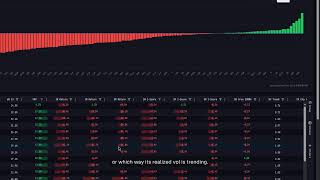
- Multi-Dimensional Screening (Cockpit): Traders can contextualize individual stock performance by comparing realized volatility trends, technical moving averages, and cross-sector behaviors simultaneously.
- Natural Language Interface (MoonBot): AI-driven assistants allow traders to query complex quantitative option screens using plain English, lowering the barrier to institutional-grade analysis.
- P&L Attribution: Understanding exactly why a trade made or lost money requires breaking down returns across the Greek risk parameters: gamma, theta, and vega.
- Implied vs. Realized Correlation: Comparing what the options market is pricing in terms of asset correlation against what actually transpired allows traders to identify index and basket mispricings.
Quotes
- At 0:15 - "The other 1%, the vol traders and market makers, look at it in reverse. They have no opinion on direction. Their only question is which options are cheap and which are expensive?" - highlighting the conceptual shift from directional speculation to relative value volatility trading.
- At 0:54 - "Our workflows, Defensive, Income and Verticals, start from that reason and use our vol opinions to filter for the candidates that fit it." - explaining how the platform translates specific user intent into quantitative options filtering.
- At 2:16 - "We organize everything so you can quickly see what's abnormal, and check whether the trade you want is actually cheap or expensive in the context of the whole market." - summarizing the ultimate value proposition of the Moontower platform.
Takeaways
- Shift your options evaluation framework from asking "is this stock going up or down?" to analyzing whether the implied volatility is underpriced or overpriced relative to its history.
- Match your options strategy to specific portfolio objectives by utilizing structured workflows, such as selecting a "Defensive" setup for hedging or an "Income" setup for yield generation.
- Perform post-trade audits using P&L attribution tools to systematically verify whether your returns were driven by directional movement, time decay, or volatility changes.