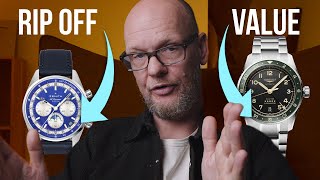
Longines— Why they're the best value watch brand today
Audio Brief
Show transcript
This episode covers why Longines has emerged as the value king in the entry-level luxury watch market, specifically dominating the fifteen-hundred to three-thousand dollar price range.
There are three key takeaways from this analysis. First, Longines strategically leverages the scale of the Swatch Group to offer superior movement specifications and finishing at a lower price point than competitors like Tudor. Second, the brand maintains a massive global retail and service network that easily outperforms microbrands offering similar technical specifications. Third, despite its market dominance, Longines faces long-term risks due to conservative designs and a lack of emotional appeal among enthusiast communities.
Looking at the first takeaway, Longines utilizes customized Swiss-made ETA movements to deliver high-performance watches at a significant discount. For example, the Longines Spirit line offers a certified chronometer with the same power reserve and finishing quality as the Tudor Ranger, but for six hundred dollars less. This positioning allows the brand to dominate the critical price tier where consumers transition from simple utility to emotional and financial investments.
Regarding the second takeaway, Longines quietly sells one point five million watches annually, vastly outperforming media-darling competitor brands. This immense scale provides them with a massive global dealer network and robust after-sales service that smaller independent brands simply cannot match. Consequently, everyday models like the Conquest and HydroConquest lines serve as the ultimate industry benchmarks for build quality and reliability in their price category.
Finally, the third takeaway highlights the brand's primary vulnerability, which is its reliance on safe, middle-of-the-road designs. By targeting a broad mass market with mainstream celebrity ambassadors, Longines risks becoming forgettable to passionate collectors who drive industry trends. As competing brands rapidly improve their manufacturing capabilities, Longines must balance its high-volume efficiency with more distinct, emotional desirability to maintain its position.
For buyers navigating the entry-level luxury landscape, Longines currently offers an unmatched combination of Swiss heritage, technical specifications, and global support.
Episode Overview
- This episode explores why Longines is currently the "value king" in the luxury watch market, specifically in the $1,500 to $3,000 price range.
- It examines how Longines stacks up against competitors like Tudor, Formex, and Seiko in terms of specs, movement quality, and finishing.
- The host explains Longines' unique market positioning within the Swatch Group and how they differentiate their product lines.
- It highlights why Longines, despite selling millions of watches, is often overlooked in enthusiast media and discusses the brand's long-term risks.
Key Concepts
- The $1,500–$3,000 Sweet Spot: In this price tier, watches transition from a simple cost to a significant emotional and financial investment. Consumers demand premium finishing, a reputable heritage, and longevity, making it one of the most competitive segments in the industry.
- Enthusiast vs. Mass-Market Noise: Brands like Tudor dominate watch enthusiast media and YouTube channels, but Longines quietly outsells them by a massive margin (1.5 million watches per year compared to Tudor's ~250,000).
- Strategic Swatch Group Positioning: Within Swatch Group, Longines sits perfectly in the "quality watch value" space. This position allows them to leverage Swiss-made ETA movements (tailored to Longines' specs) while offering high-quality cases and bracelets at a lower price point than independent competitors.
- Vertical and Horizontal Differentiation: Longines categorizes its lines logically (Conquest for everyday sports, Spirit for premium tool watches, Heritage for enthusiasts), and pricing rises strictly based on mechanics and complications (from Quartz up to COSC-certified and high-frequency movements).
- The "Boring but Good" Risk: Longines' biggest weakness is its lack of emotional flair. By playing it safe with middle-of-the-road designs and mainstream celebrity ambassadors (like Henry Cavill and Jennifer Lawrence), they risk becoming forgettable as other brands improve their manufacturing capabilities.
Quotes
- At 0:23 - "Tudor have been the value leader, but they're not anymore... there is one brand that is the new value king... and it's Longines." - Setting up the thesis of the episode by shifting the crown from Tudor to Longines in the entry-level luxury space.
- At 3:32 - "At that $1,500 point and up, it turns into not just a cost, but also a significant investment decision. So people want to know they're really not wasting their money." - Explaining the psychological shift of consumers when purchasing watches in this specific luxury tier.
- At 12:20 - "You change that to a 72-hour power reserve movement, and the [Formex] Essence and [Longines] Spirit are going to be incredibly close in price... and Longines has dealers everywhere." - Illustrating how Longines' massive dealer network and retail presence give it a definitive edge over microbrands with similar specifications.
Takeaways
- Look at Longines' Spirit line if you want a COSC-certified chronometer that offers the exact same performance, power reserve, and finishing quality as the Tudor Ranger but at a $600 discount.
- Use the Conquest and HydroConquest lines as benchmark references for everyday sports watches and dive watches when evaluating similar offerings from Seiko or other Swiss brands.
- Do not let enthusiast media bias dictate your watch collection; recognize that high-volume, less-talked-about brands like Longines often provide the most robust build quality and after-sales service network for your money.