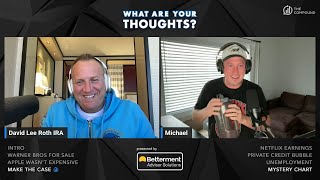
Is Tim Cook the Greatest CEO of All Time? | WAYT?
Audio Brief
Show transcript
In this conversation, the discussion focuses on the infrastructure battle for enterprise artificial intelligence, the operational realities of scaling technology, and the psychological traps that drive market volatility.
There are four key takeaways. First, artificial intelligence must run directly within existing data repositories to protect security and manage costs. Second, real-world technology deployment is an evolutionary process that lags behind public relations. Third, operational execution and capital discipline yield greater value than visionary creation, and finally, investors must prioritize fundamentals over narrative-driven market swings.
The architectural competition between Snowflake and Databricks highlights the power of data gravity. Because moving massive enterprise datasets is both costly and risky, artificial intelligence models must be integrated directly into existing data warehouses. This integration is increasingly focused on unlocking unstructured data, such as audio files and documents, which represents the next frontier of business intelligence.
While executive press releases suggest instant transformations, real-world deployment relies on slow, incremental progress. Companies are increasingly adopting orchestration layers that automatically route tasks to the most cost-effective and specialized models. This pragmatic approach makes artificial intelligence spending highly sticky, distinct from previous experimental technology cycles.
Evaluating corporate leadership requires looking beyond pure product innovation to operational execution. Apple under Tim Cook exemplifies how supply chain mastery, margin expansion, and extreme capital discipline can outperform creative genius. Knowing which acquisitions to avoid is often just as valuable as the deals a company chooses to pursue.
Market sentiment frequently decouples from business fundamentals during periods of narrative shifts or software sell-offs. Investors who succumb to cognitive biases often exit high-quality positions right before earnings prove the market consensus wrong. Relying on a single outperforming factor is a dangerous strategy, as market dynamics inevitably shift just as a trend reaches peak popularity.
Ultimately, navigating high-stakes technology transitions requires distinguishing between short-term noise and long-term operational execution.
Episode Overview
- The Battle for Enterprise AI Infrastructure: The episode dives deep into the high-stakes architectural competition between data giants Snowflake (SQL-centric) and Databricks (ML-native), exploring how the necessity of data gravity forces AI models to run directly where sensitive corporate data resides.
- Debunking the AI Hype vs. Reality: The hosts analyze the massive chasm between corporate public relations and actual technical implementation, framing AI as an evolutionary enterprise journey rather than an overnight revolution.
- The Operational Masterclass of Tim Cook: The narrative shifts to corporate leadership, contrasting Steve Jobs' creative genius with Tim Cook's unprecedented operational success, supply chain mastery, and disciplined capital allocation at Apple.
- Market Psychology and Factor Regime Shifts: The discussion unpacks the cognitive biases that trigger market panics (such as the "Gell-Mann Amnesia" effect during software sell-offs) and warns against the dangers of performance-chasing volatile investment factors.
Key Concepts
- Data Lake Architecture (SQL vs. ML): Snowflake (historically structured SQL data for business intelligence) and Databricks (unstructured data for machine learning models) are rapidly converging. Understanding this architectural divide is crucial, as the real frontier of AI utility lies in tapping into massive, unstructured datasets like audio recordings and documents.
- The AI "Layer Cake" and Orchestration: Modern enterprise AI infrastructure requires multiple layers—data storage, query engines, LLMs, and orchestration layers (AI "harnesses"). These orchestration layers automatically route tasks to the most cost-effective and efficient model, driving down compute costs and reducing reliance on a single LLM.
- The Polarization of the AI Thesis: The market is divided between optimistic builders viewing AI as a foundational technology shift (akin to the early internet) and critics viewing it as a capital-expenditure bubble. However, unlike previous hype cycles (Metaverse, crypto), AI spending is structurally sticky because enterprises are actively integrating it into workflow efficiencies rather than treating it as an optional experiment.
- The "Gell-Mann Amnesia" Effect in Investing: A cognitive bias where investors recognize that public media coverage of their own industry is highly inaccurate, yet turn the page and believe generalized, panicky headlines about other industries. This bias often drives irrational market sell-offs of high-quality software companies despite unchanged business fundamentals.
- Tim Cook’s Legacy as the Ultimate Operator: True executive genius can manifest as operational excellence rather than product invention. Cook’s mastery of supply chains, margin expansion on physical hardware, and geopolitical navigation has yielded superior shareholder returns compared to pure visionary creation.
- The Transience of Investment "Holy Grails": Investment styles and factors undergo extreme regime shifts. When a specific strategy (like momentum) achieves consensus as the "only" way to win, the market dynamics quickly shift, proving that no single style works indefinitely.
Quotes
- At 0:06:54 - "If you want to do agentic shit, congratulations, you're going to do it right here in the data warehouse. You are not going to be duplicating data, you're not going to be moving your data around to all these platforms. The LLMs are going to come into the Snowflake environment..." - explaining how Snowflake positions itself to prevent data gravity loss to external AI platforms.
- At 0:08:08 - "It's a battle between two different types of architecture. Snow is built on SQL... Databricks is AI native, and everything is built in ML... What both platforms are doing is copying each other." - outlining the competitive convergence of the two leading data infrastructure giants.
- At 0:09:44 - "A recording of this podcast is unstructured data. It is not rows and columns... The world of unstructured data is enormous and relatively untapped, whereas the way corporations have been keeping data for a million years, that's SQL." - detailing why the battle over unstructured data is the real frontier for AI utility.
- At 0:20:10 - "People are really, really sick of being told by people on the West Coast that their jobs are cooked. Ed [Zitron] is not shaping that narrative, he's riding the wave." - explaining the psychological appeal of the AI skeptic movement.
- At 0:22:27 - "Acting like this is the final product is crazy... I remember the original internet... downloading a song on Napster took forever... Imagine judging it as a final product two years after [it launched]." - urging patience by drawing a parallel between early, clunky AI tools and the early, slow days of the Web.
- At 0:23:27 - "If you took a meeting with the CEO of Goldman Sachs, he would say they are so deep in it. But if you got the CTO of Goldman Sachs drunk, he'd be like, 'Yeah, I'm just announcing shit.'" - illustrating the massive gap between corporate PR hype and actual technical implementation of AI.
- At 0:30:50 - "Not everybody is Uber-sized where they have enough engineers to make these determinations themselves." - explaining why software integration platforms ("harnesses") have become multi-billion dollar businesses for smaller enterprises trying to optimize AI compute costs.
- At 0:32:05 - "Where are we in the adoption curve of AI in daily life in corporate America? We're nowhere. We are nowhere. I really don't think the transformation has even started to begin." - highlighting the massive gap between current market valuation hype and actual deep enterprise integration of AI tools.
- At 0:34:03 - "No one's going to go backwards. No one's going to be like 'ah, we gave it a shot, rip it out.' It's very unlike the Metaverse in that way... it's very unlike crypto." - explaining why AI spend is structurally sticky; while companies may optimize or pause, they will not abandon the technology as they did with previous hype cycles.
- At 0:35:10 - "I think he’s a better CEO than Steve Jobs... I would not say he's a better inventor, or product creator, or creative... but I think he's the best CEO of all time." - distinguishing between the role of a visionary founder and the role of a chief executive officer managing a multi-trillion-dollar public enterprise.
- At 0:39:31 - "Through the insane drawdown—and it was insane... the market was saying 'we don't care about Adobe's all-time high in earnings because we don't believe it's sustainable.' The market was wrong." - illustrating how sentiment can completely decouple stock prices from stellar underlying business performance.
- At 0:41:07 - "Gross margins are up 820 points during Tim Cook's tenure... This is a consumer technology play. Nobody in a million years ever thought this would be possible." - emphasizing the sheer operational marvel of expanding margins on physical hardware at Apple's scale.
- At 0:45:20 - "Sometimes you should be judged on all the things that you don't do... Think about having $300 billion in cash for 15 years and not doing a [bad] deal." - advocating for the value of executive restraint and capital preservation over dilutive mergers and acquisitions.
- At 0:51:17 - "Just when you think you have the key to the lock, they change the lock... You will never find a style or strategy that always works." - warning investors against performance-chasing based on short-term factor dominance.
Takeaways
- Bring the Models to the Data: When designing or investing in enterprise systems, prioritize keeping AI models within the existing data warehouse/lake to preserve data gravity, maintain security compliance, and eliminate the costly, risky transfer of datasets.
- Utilize Orchestration Layers to Optimize Costs: Rather than relying on a single, expensive proprietary LLM, implement orchestration harnesses to automatically route specific tasks to the most cost-effective and task-appropriate open-source or specialized model.
- Judge Tech Shifts by Ground-Level Utility, Not PR: Ignore executive-level press releases regarding immediate AI transformations; instead, look for slow, incremental, bi-weekly developer integrations to evaluate actual technical progress.
- Value Executive Restraint and Capital Allocation: When evaluating leadership, assess what mergers and acquisitions a CEO refuses to do. Conserving cash to fund massive share buybacks can generate far higher shareholder value than dilutive, trend-chasing acquisitions.
- Ignore Sentiment Decoupling in Core Holdings: When macroeconomic or narrative panics (such as "AI will kill SaaS") drive down the stock prices of high-quality companies, look directly at earnings estimates and underlying fundamentals rather than the prevailing headline sentiment.
- Maintain a Diversified Investment Style: Avoid overallocating capital to a single outperforming factor (such as momentum) at its peak, as the subsequent structural unwinds are historically swift and violent.