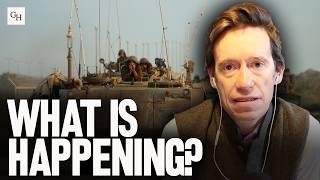
Is This the Middle East's New NATO?
Audio Brief
Show transcript
This episode covers the emergence of the Saudi-Turkey-Pakistan Mecca Joint Defense Agreement and the broader shift toward autonomous regional security alliances outside of traditional Western influence.
There are three key takeaways from this geopolitical realignment. First, the decline of the United States security umbrella is driving historic allies to form independent defense pacts. Second, modern asymmetric warfare is creating an unsustainable financial imbalance, where low-cost drones easily deplete multi-million-dollar air defense stockpiles. Third, middle powers are leveraging their increased economic strength to secure alternative global partnerships, permanently altering the traditional balance of power.
The newly formed alliance between Saudi Arabia, Turkey, and Pakistan features a collective defense clause modeled after NATO's Article 5. This landmark agreement signals a profound shift toward regional military self-reliance completely independent of Washington's command. As trust in American deterrence continues to erode, regional powers are increasingly taking security matters into their own hands.
Modern air defense faces a critical economic crisis due to the proliferation of cheap drone technology. Military forces are routinely forced to fire four-million-dollar Patriot interceptor missiles to shoot down decoy drones that cost only thirty thousand dollars. This unsustainable rate of financial attrition quickly depletes Western stockpiles and leaves nations vulnerable to prolonged gray-zone conflicts.
Economic growth over the past three decades has allowed middle powers to expand their diplomatic and military options beyond Western alliances. These nations can easily turn to alternative partners like China when Western powers attempt to weaponize dependency. Concurrently, hostile actors are using gray-zone drone tactics to map critical infrastructure and trigger public anxiety, bypassing traditional defense frameworks altogether.
As these independent defense networks take root, Western policymakers must adapt to a multiplex world order where traditional security umbrellas no longer hold absolute sway.
Episode Overview
- Explores the emergence of the Saudi-Turkey-Pakistan Mecca Joint Defense Agreement, a powerful new military alliance forming outside the U.S. sphere of influence with a collective defense clause modeled on NATO's Article 5.
- Analyzes the decline of U.S. security guarantees and deterrence in the Middle East, which has driven historic regional allies to seek autonomous security arrangements to manage threats.
- Highlights the severe economic and material strain of asymmetric warfare, where low-cost enemy drones exhaust highly sophisticated, multi-million-dollar Western air defense stockpiles.
- Examines the rise of "gray-zone" tactics and psychological warfare, showing how middle powers and non-state actors leverage accessible drone technology to bypass traditional defenses and exert geopolitical pressure.
Key Concepts
- The Saudi-Turkey-Pakistan Alliance: A major geopolitical realignment linking nuclear-armed Pakistan, oil-rich Saudi Arabia, and Turkey's massive conventional military. Modeled on NATO's Article 5, its collective defense clause signals a shift toward regional military self-reliance completely independent of U.S. command.
- The Erosion of the U.S. Security Umbrella: Historically, a U.S. military presence guaranteed protection for Gulf partners. Recent uncountered regional attacks have severely eroded trust in American deterrence, forcing regional powers to manage threats through localized pacts.
- Asymmetric Financial Attrition: Modern warfare features a massive cost imbalance. Decoy drones costing tens of thousands of dollars are routinely countered by $4 million Patriot interceptor missiles, creating an economically unsustainable defense model that depletes Western stockpiles.
- The Democratization and Proliferation of Drone Tech: Access to cheap drone technology has leveled the playing field, allowing smaller states, insurgent groups, and criminal networks to bypass traditional military superiority and disrupt critical infrastructure.
- The Strategy of "Collective Anxiety": Hostile actors use low-scale, persistent gray-zone provocations—such as flying small drones near European infrastructure—not to cause physical destruction, but to map defense response protocols and induce public and political panic.
- The Rise of Middle-Power Leverage: The massive economic growth of nations like Turkey and Saudi Arabia over recent decades means they are no longer dependent on Western powers; they can actively leverage alternative partnerships, such as with China.
Quotes
- At 1:28 - "Any attack against any of the three states shall be regarded as an attack against them all. Of course, that's what's made people make the link with NATO Article 5." - Explains why analysts view the Saudi-Turkey-Pakistan pact as a major geopolitical shift toward an independent "Islamic NATO."
- At 2:18 - "Having U.S. bases and having a U.S. presence in the Middle East for 60, 70 years has been seen as an almost guarantee of protection—almost immunity... And that began to crack apart." - Illustrates the psychological and strategic breakdown of traditional American security guarantees in the region.
- At 6:09 - "This is setting up something which has no U.S. imprint, coordination, or strategy at all. And that's something that I think should really worry Washington." - Outlining the strategic challenge for the West as regional powers build military coordination frameworks outside of CENTCOM.
- At 11:21 - "By saving money [in the short term], they actually weakened themselves... they changed it from them being a deterrent of last resort... into a world in which they became an exploitative force, weaponizing dependency and driving their allies away." - Critiquing isolationist U.S. policies that sacrifice long-term influence and alliance trust for short-term financial savings.
- At 21:28 - "Every time [a Patriot missile] went off, it cost $4 million... what the Iranians have worked out is they can put a drone up there costing, you know, 20 grand, 30 grand... but it's taking a Patriot interceptor to bring it down." - Explaining the severe, unsustainable economic imbalance defining modern air defense.
- At 28:43 - "The relationship between countries like Britain and countries like Turkey and Saudi Arabia... since 1989, the British economy has broadly grown three or four times larger. The economies of Saudi Arabia and Turkey are 15 times larger... Saudi has so many more options, and China of course has much more capacity." - Highlighting how the shifting economic balance of power gives middle powers alternative diplomatic partners.
- At 29:25 - "The U.S., rather than leaning into these relationships, treasuring them, bringing people ever closer to themselves, decided to weaponize them at a time when there are alternatives out there." - Explaining how trying to force ally dependency backfires in a multiplex world where nations can easily align with China instead.
- At 34:00 - "Provoking a 'collective anxiety attack' is not just about making the politicians feel they've got a problem on their hands, it's making all of us feel worried, anxious, nervous." - Detailing the psychological goals of hostile gray-zone operations targeting domestic populations.
Takeaways
- Prepare for a Multiplex World Order: Foreign policy strategies must adapt to a world where middle powers bypass Western leadership to form independent, overlapping regional defense and economic pacts.
- Redesign Air Defense and Military Procurement: Defense planners must rapidly transition from high-cost, limited-stockpile interceptor missiles to scalable, cost-effective counter-drone systems to survive asymmetric attrition warfare.
- Prioritize Alliance Trust Over Short-Term Savings: Policymakers must recognize that pulling back security commitments damages long-term deterrence, breaks trust, and drives vital regional partners toward alternative adversaries like China.
- Develop Strategies to Counter Gray-Zone Tactics: Governments and security forces must establish protocols to handle low-boil, persistent drone incursions designed to map infrastructure defenses and stir public panic.
- Monitor the Global Proliferation of Battle-Tested Tech: Security agencies must track the rapid export of advanced, low-cost drone tactics from primary war zones (like Ukraine) to secondary conflicts, insurgencies, and criminal organizations worldwide.