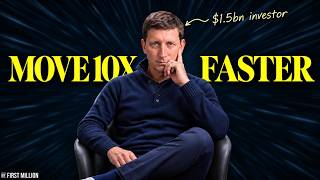
How to stop watching your life and start living it - Robert Greene

Audio Brief
Show transcript
Shaan Puri offers a chilling thought experiment: over 90 percent of adult Americans own a smartphone, and 80 to 90 percent of them are addicted for about seven hours a day. On this episode of their show, released on November 11, 2026, hosts Shaan Puri and Sam Parr talk with author Robert Greene. You will learn how to escape digital addiction to experience the sublime, master the hidden psychology of power and charisma, and tap into your deepest human potential.
How to break algorithmic rewiring and restore your restless brain. Greene admits he cannot back his tech crisis claims with data, but argues that Instagram, X, and TikTok uniquely alter our minds by replacing personal agency with passive external hits. This leaves adults feeling flat even when traveling to places like Bali, unlike toddlers who find the world wondrous simply because they do not yet understand it. To break this programming, lock your phone in a drawer at home and take a cold turkey walk in nature with a friend who also leaves their phone behind.
Trade that passive scrolling for real adversity, and you can unlock dormant, almost superhuman powers through purpose. After a 1972 plane crash at the foot of a 14,000 foot mountain in the Andes, Uruguayan rugby player Nando Parrado survived by eating the dead and spent two hours cutting holds into a vertical wall of rock and ice with airplane scraps, driven by love for his father. Anchor your own life to a concrete, unfinished project or a person to support, and measure yourself against arduous challenges like climbing a mountain to force your hidden resources to the surface.
That same stroke also revealed how a dying brain strips away the illusion of everyday reality. Citing neuroscientist and skeptic Susan Blackmore, Greene explains that a dying brain stops constructing its familiar filter of time and reality. When Greene woke from his stroke and coma, that dissolved filter left him with a weird taste, the feeling of his bones dissolving, and a view of the Los Angeles sky as incandescent, like on fire, which removed his fear of death.
How strategic silence builds massive power in an age of oversharing. Parr highlights venture capitalist Josh Kushner, who is worth probably 15 billion dollars, bought the Lakers, and wins deals by keeping zero public social media presence. Practice this first law of power by saying less than necessary and keeping personal details like meals or travel photos off social media.
Why human nature's dark side will trigger an artificial intelligence backlash. Technology amplifies the traits of its creators, and referencing the 18 dark traits from his book The Laws of Human Nature, Greene predicts humans will use artificial intelligence, or AI, for escalated phone phishing, biological weapons, and dirty bombs. Protect your own cognitive discipline by reading full length books and writing your own drafts rather than relying on AI summaries.
How childhood wounds and channeled anger fuel unforgettable charisma. Researching The Art of Seduction, Greene found that a huge percentage of charismatic icons like Marilyn Monroe had abused, abandoned, or orphaned childhoods that drove a desperate need for public validation, whereas figures like 50 Cent, Malcolm X, and Winston Churchill drew magnetism from unshakeable confidence and channeled inner anger. You can channel your own anger, trauma, or failure into disciplined study and preparation, following the model of Malcolm X reading in a prison library.
Why monumental greatness does not require personal virtue. Greene argues that Kobe Bryant and Steve Jobs, whom Greene calls the worst manager in the world early on, got things done precisely because they were not paragons of virtue.
Human potential is unlocked not through digital comfort or moral perfection, but by embracing silence, channeling our darkest struggles, and measuring ourselves against impossible challenges. We put limits on what we think we can do, but there are actually no limits.
Episode Overview
- Robert Greene talks with Shaan Puri and Sam Parr about escaping technology addiction to experience the sublime, the hidden psychology of power and charisma, and how his near-death stroke transformed his view of human potential.
- The conversation begins by examining how algorithms and smartphones rewire the restless human brain, leaving modern adults feeling flat and disconnected compared to the natural wonder experienced in early childhood.
- Greene illustrates the concept of the dynamical sublime through historical survival stories and his own seven-year recovery from a near-fatal stroke, showing how extreme adversity and purpose unlock dormant human capabilities.
- The discussion transitions to practical dynamics of power in the digital age, covering the strategic value of silence and mystery, alongside Greene's warnings about how dark human traits will shape the future of artificial intelligence.
- The episode concludes with an analysis of political narrative, the roots of charisma in childhood trauma and inner intensity, and why society must separate monumental achievement from personal virtue.
Key Concepts
- Algorithmic Rewiring vs. The Restless Brain: In a short evolutionary span of 40,000 years, humans developed a language-capable brain that consumes massive physical energy and requires constant stimulation. Puri offers a thought experiment suggesting that over 90% of adult Americans have a smartphone, with 80% to 90% of them addicted at a dosage of about 7 hours a day. While Sam Parr notes that crime is lower than ever and ancient Babylonian stone tablets show older generations have always complained about the youth, and Greene admits he cannot quantify historical misery or back his tech crisis claims with data (noting people in the 1920s and 1930s used "four or five whiskeys at dinner" and cigarettes, or ale in historical England, like modern antidepressants), Greene argues that Instagram, X, and TikTok uniquely alter the mind. Replacing personal agency with passive external hits leaves people feeling flat, even when traveling to places like Bali, unlike 2- to 4-year-old children who experience the world as wondrous because they do not yet understand it.
- The Dynamical Sublime and Purpose-Driven Survival: In his new book The Law of the Sublime (which Greene is actively promoting alongside his backlist titles), Greene argues that humans possess dormant, almost superhuman powers that only emerge when measuring oneself against the immense and impossible. He illustrates this with the 1971 to 1972 Andes plane crash at the foot of a 14,000-foot mountain (citing about 45 people on board, and later noting 18 of 50 survived), where Uruguayan rugby player Nando Parrado survived by eating the dead and spent 2 hours cutting holds into a vertical wall of rock and ice with airplane detritus, driven by love for his father. Similarly, Parr cites The Escape Artist (about an Auschwitz escapee who hid under dead bodies for 3 days), and Greene cites Viktor E. Frankl's Man's Search for Meaning to show that camp survivors were those who held onto a specific future purpose, just as Greene survived 60 jobs in his 20s and 30s and later a stroke that left him with one usable hand because he needed to write.
- The Death Sublime and Constructed Reality: Reviewing near-death experience (NDE) literature since the 1960s, Greene notes that approximately 85% ("more or less") of NDEs are deeply peaceful and positive, sometimes converting atheists, while about 15% ("or so, don't quote me on the exact number") are hellish nightmares. Citing neuroscientist and skeptic Susan Blackmore's book Dying to Live: Near-Death Experiences, Greene explains that a dying brain stops constructing its familiar filter of time and reality. Unlike LSD hallucinations (which Greene has experienced and notes involve seeing light waves that are not there), Greene's own stroke and coma dissolved his brain's normal filter—leaving him with a weird taste, the feeling of his bones dissolving, and waking to see the Los Angeles sky as "incandescent, like on fire"—allowing him to perceive reality as it actually is and removing his fear of death.
- The Dialectic of Absence and Presence in Power: Power relies on maintaining mystery and controlling how much of oneself is revealed to the world. In an era of constant oversharing, strategically withdrawing creates value and intrigue; Greene points to Beyoncé disappearing for a year and a half before releasing an album as a prime example. Sam Parr reinforces this with the case study of 41-year-old venture capitalist Josh Kushner, who invested in Instagram at age 21, is worth probably $15 billion, bought the Lakers, and wins deals by maintaining zero public social media presence and cultivating mystique.
- Human Nature's Dark Side and the AI Backlash: Technological tools do not exist in a vacuum; they amplify the underlying traits of their creators. Referencing the 18 dark traits from his book The Laws of Human Nature (specifically irrationality, grandiosity, envy, short-sightedness, and self-absorption), Greene predicts humans will use AI for escalated phone phishing, biological weapons, and dirty bombs. Furthermore, he predicts that AI will decimate the legal profession, erode young people's mental discipline by replacing 400-page books and essay writing with paragraph summaries, and trigger a bottom-up political backlash demanding laws to regulate AI and cap data centers.
- The Roots of Charisma and Mythmaking: Effective leadership requires projecting a larger-than-life myth rather than a laundry list of policies, a point Greene emphasized when consulting with politician Tim Ryan and Republican Steve Schmidt about appealing to an American myth of rugged, practical builders. Examining historical charisma, Greene notes how JFK modeled his television persona on actor Montgomery Clift to defeat a sweaty Nixon in the eyes of TV viewers (while radio listeners thought Nixon won), though Greene hedges that he does not know how fading attention would have affected JFK emotionally since he had physical ailments and was assassinated young. Researching The Art of Seduction, Greene found that a massive percentage of charismatic icons like Marilyn Monroe had abused, abandoned, or orphaned childhoods, projecting a desperate need for public validation, while figures like 50 Cent (who survived 9 close-range gunshot wounds), Malcolm X, and Winston Churchill drew magnetism from unshakeable confidence and channeled inner anger or crisis.
- The Separation of Greatness and Virtue: Society mistakenly expects monumental achievers to be kind, balanced, and saintly, when in reality, transformative drive often stems from dark or obsessive traits, such as Puri's admission of scoring over 100 on narcissism (defined on his coach's test as believing you are special and seeking world validation). Greene argues that figures like Kobe Bryant or Steve Jobs (whom Greene calls "a raging asshole" and "the worst manager in the world" early on) got things done precisely because they were not paragons of virtue. However, greatness and empathy can occasionally coexist, which Greene illustrates through Ryan Holiday (whom Greene discloses is his former researcher and mentee) and Oklahoma City Thunder head coach Mark Daigneault (whom Greene discloses is a personal friend, hedging that Daigneault played basketball at "I believe in the college level, don't quote me on that"), who won an NBA championship after rising from the G-League by pairing analytical strategy with deep empathy for his 15 wealthy young players.
Quotes
- At 0:04:20 - "We have technology on this new level, social media on this new level, and in some ways it's altering people, it's altering our minds, it's rewiring our brains in ways that aren't necessarily healthy, and this is a new phenomenon." - Greene explains why modern digital distractions differ from historical vices.
- At 0:07:20 - "They're walking in the most spectacular, in Los Angeles, in this beautiful, you know, bucolic part, nature part, park, and they're like this, right? They're talking to someone or they're like reading something off Instagram while they're walking outside. That to me is like mental illness to me." - Greene illustrates how smartphones sever human awareness from the immediate physical environment.
- At 0:08:37 - "When you have a generations of people that everything is fast and easy and quick, you can get things at the tip of your fingertips without any effort, it's rewiring the brain, it's rewiring human nature. It's creating people who are spoiled, who expect everything to be fast and easy, who have no patience to write an essay, who have no patience to read a 400-page book because, well, I can just get AI to give me the paragraph on it, you know?" - Greene warns how frictionless technology and AI summaries destroy mental discipline.
- At 0:10:49 - "Get outside your house, go out into nature, go out into Central Park or go out into Connecticut somewhere, and leave your goddamn phone behind, lock it in a drawer, you can't possibly access it." - Greene shares his core prescription for breaking algorithmic programming and restoring outward focus.
- At 0:17:28 - "You can't get that from your goddamn fucking phone, you can't get that feeling of climbing a mountain, I did something difficult, arduous, but I feel, wow, look at this, right? There's no experience that could be programmed on your stupid phone that can ever give you that kind of sensation." - Greene contrasts passive digital stimulation with the earned internal fulfillment of the sublime.
- At 0:22:57 - "We put limits on what we think we can do, but there are actually no limits. You put people in difficult situations, it either crushes them or they rise to a new level, they discover new resources in themselves." - Greene summarizes the lesson of the 1972 Andes plane crash survivors and the dynamical sublime.
- At 0:26:28 - "And it was a matter of seconds, if they had arrived 30 seconds later or a minute later, I'd either be dead or I'd have intense brain damage. And so I survived that, I'm alive, there must be a reason for that." - Greene reflects on how his near-fatal stroke in Los Angeles reinforced his sense of purpose.
- At 0:29:45 - "Always say less than necessary. People talk way too much. They're always talking, talking, talking, talking, particularly in the era of social media, they're just revealing way too much about themselves. Learn to withdraw. Power is about absence and presence." - Greene outlines what he would teach as the very first lesson in a college course on power.
- At 0:37:22 - "When you create a new piece of technology like this, it's not like something that just comes out of nowhere, it's humans that created it. And now that dark side of human nature is going to be able to use this new technology for very, very dangerous purposes." - Greene predicts how human irrationality, envy, and grandiosity will drive the misuse of artificial intelligence.
- At 0:44:46 - "Your brain constructs the world that you see. You don't realize that it isn't reality what you're experiencing right now, your brain is constructing what you consider to be reality. And when the brain is dying, that reality that it's been constructing for you throughout your whole life breaks down, and now you're actually seeing things as they are without the brain meddling in this." - Greene explains the neurological and perceptual shift that occurs during a near-death experience.
- At 0:47:43 - "No, I'm kind of not really afraid of it. At sometimes I almost like yearn for the peace that it represented." - Greene reveals how his coma and near-death experience eliminated his fear of dying.
- At 0:58:29 - "About a huge percentage of people that we would consider charismatic come from very troubled backgrounds. They had very difficult childhoods, they were either abused or abandoned or orphans, had very, very difficult childhoods. And so their whole life, their whole sense of getting power and love was through the camera, was through the public." - Greene uncovers the psychological wound driving the magnetism of public icons like Marilyn Monroe.
- At 1:08:47 - "I think we have to get over this notion that being great and powerful also makes you a wonderful, loving, kind person, because a lot of very creative people in the arts or in politics or in business get very far, but they're not the nicest people in the world, but so what? Why does everyone have to be these paragons of virtue?" - Greene challenges the modern expectation that high-achieving leaders must be morally saintly.
Takeaways
- Lock your phone in a drawer at home and take a "cold turkey" walk in nature with a friend who also leaves their phone behind, forcing your brain to overcome initial withdrawal and focus on physical movement, sounds, and non-human surroundings.
- Generate internal stimulation when traveling or resting by disconnecting from your schedule and Instagram feed, slowing down your perception of time to recapture the natural wonder of early childhood.
- Measure yourself against immense and arduous challenges, such as climbing a mountain or tackling a seemingly impossible project, to force dormant physical and mental resources to the surface.
- Anchor your life to a concrete, unfinished purpose—such as a specific project to complete or a person to support—to build resilience against depression and physical adversity.
- Practice the first law of power by saying less than necessary and strategically withdrawing from public view, using silence to cultivate mystique rather than oversharing personal details like meals or travel photos on social media.
- Protect your cognitive discipline by reading full-length books and writing your own drafts rather than relying on AI to generate paragraph summaries.
- Adapt to severe physical or situational limitations by breaking monumental work into iterative manual steps, following Greene's example of handwriting, rewriting 4 to 5 times across 120 notebooks, dictating, and hand-editing his book with one usable hand.
- Channel negative internal emotions like anger, past trauma, or professional failure into disciplined study and preparation, following the model of Malcolm X reading in a prison library or Winston Churchill rising after Gallipoli.