How to Fix a Book: From Hinge Repair to Page Tears

Audio Brief
Show transcript
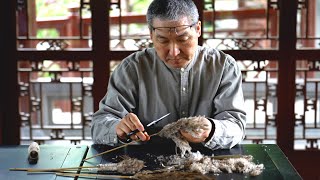
This episode covers fundamental book repair techniques from a professional conservator at The Huntington Library.
There are three key takeaways from this discussion.
First, for long-lasting and non-damaging repairs, always use archival, reversible materials. Wheat starch paste is an ideal adhesive for paper repairs because it is strong, dries clear, and can be removed with water without harming the original paper. Avoid common household items like tape, which cause permanent damage.
Second, when repairing a paperback book with a broken spine, it is crucial to first remove all the old, brittle glue. Then, press the separated pages together to remove any air, ensuring the newly glued text block will be compact enough to fit back into its original cover. This is part of the double-fan adhesive repair method.
Third, to create a nearly invisible mend on a torn page, tear Japanese tissue paper instead of cutting it. Tearing creates a soft, feathered edge that blends seamlessly into the page, whereas a hard, cut edge will always remain visible. This technique is essential for strong yet subtle tissue repairs.
These practical techniques offer stable, long-lasting, and reversible solutions for common book issues at home.
Episode Overview
- Learn three fundamental book repair techniques from Mitchell Gundrum, a professional book conservator at The Huntington Library, Art Museum, and Botanical Gardens.
- The episode provides step-by-step instructions for repairing common issues in paperback books, hardcover books, and individual torn pages.
- Discover which archival materials to use, such as Japanese tissue and wheat starch paste, and why you should avoid common household items like tape.
- The host demonstrates each technique on different types of books, offering practical tips for achieving stable, long-lasting, and reversible repairs at home.
Key Concepts
- Double-Fan Adhesive Repair: A method for re-binding a paperback book whose spine has failed. This technique involves separating all pages, removing old glue, and then re-gluing the text block by fanning the pages in both directions to apply PVA glue between each leaf. A new spine lining is then attached to complete the new binding.
- Hinge Repair: This technique is used to reattach a broken or detached cover on a hardcover book. A thin, strong strip of Japanese tissue is pasted with reversible wheat starch paste and carefully applied to the inner joint, bridging the gap between the text block and the book board to create a new, flexible hinge.
- Tissue Repair: A method for mending torn pages or reinforcing weak areas on paper. It involves using a very thin, archival Japanese tissue and wheat starch paste. The key is often to tear, not cut, the tissue to create a "feathered" edge that blends seamlessly with the original paper, resulting in a strong yet nearly invisible mend.
Quotes
- At 00:45 - "As a conservator, the work that we're doing over in the conservation lab is often much more nuanced than simply deciding to do a hinge repair." - The speaker clarifies the difference between professional conservation and the simplified DIY techniques he is demonstrating.
- At 03:17 - "I've got glue on each side of each leaf, which will hold the text block together." - Explaining the core principle of the double-fan adhesive repair after applying glue to the fanned pages in both directions.
- At 09:16 - "Please don't use tape. Instead, try to use some of the techniques that I'm about to show you for tissue repair..." - The host gives a strong warning against using tape on torn book pages and introduces the proper archival method.
Takeaways
- For long-lasting and non-damaging repairs, always use archival, reversible materials. Wheat starch paste is an ideal adhesive for paper repairs because it is strong, dries clear, and can be removed with water without harming the original paper.
- When repairing a paperback book with a broken spine, it is crucial to first remove all the old, brittle glue and then press the separated pages together to remove any air. This ensures the newly glued text block will be compact enough to fit back into its original cover.
- To create a nearly invisible mend on a torn page, tear the Japanese tissue paper instead of cutting it. Tearing creates a soft, feathered edge that blends seamlessly into the page, whereas a hard, cut edge will always be visible.