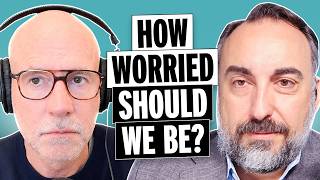
How to Fight Fascism in America — with Timothy Snyder | Prof G Conversations

Audio Brief
Show transcript
This episode explores the undeniable global return of fascism, drawing parallels to 1930s Europe and the role of corporate elites in enabling authoritarianism.
There are four key takeaways from this conversation.
First, to effectively defend democracy, it is crucial to acknowledge and name the threat of fascism without hesitation. This direct identification is a prerequisite for organizing a robust, unified response. Fascism has re-emerged as a global political force, characterized by cults of personality, propaganda, and political violence.
Second, the silence of today's corporate leaders in the face of rising authoritarianism presents a historically dangerous pattern. This inaction enables the erosion of democratic institutions for perceived short-term economic stability, echoing the complicity of German industrialists in the 1930s.
Third, a new and dangerous "oligarchic politics" has emerged. Powerful global oligarchs like Elon Musk are actively using their wealth and influence to bypass traditional state institutions and install authoritarian leaders. This model operates through a culture of favors and loyalty, subverting the rule of law.
Fourth, an internally distracted and isolationist America creates a significant global power vacuum. This weakened U.S. undermines its international credibility and provides opportunities for geopolitical adversaries like Russia and China to expand their influence and challenge the global order.
The discussion emphasizes that broad political coalitions are the only historically proven method for defeating such threats to democracy.
Episode Overview
- Yale historian Timothy Snyder argues that the global return of fascism is an undeniable reality, and that naming the threat is the first step toward combating it.
- The conversation draws strong parallels between the current political climate and 1930s Europe, specifically highlighting the role of corporate elites who enable authoritarianism for short-term gain.
- Snyder introduces the concept of a new "oligarchic politics," where wealthy individuals like Elon Musk actively work to bring fascists to power, bypassing traditional state institutions.
- The discussion covers the geopolitical consequences of a weakened, internally-focused U.S., which creates a power vacuum that benefits rivals like Russia and China.
Key Concepts
- The Global Return of Fascism: The central argument is that fascism has re-emerged as a global political force, recognizable by its cults of personality, propaganda, and political violence.
- Historical Parallels and Corporate Complicity: The silence of today's corporate leaders is compared to that of German industrialists in the 1930s, who enabled Hitler's rise in exchange for short-term benefits like crushing labor unions.
- The Rise of Oligarchic Politics: A new political model is emerging where powerful, wealthy individuals operate like "chieftains," using a culture of favors and loyalty to bypass the rule of law and install authoritarian leaders.
- The Psychology of Transgression: Modern authoritarian movements use the breaking of societal taboos (e.g., Nazi-like gestures) not just for shock value, but as a source of pleasure and a method to normalize extremism and dismantle democratic norms.
- The Necessity of Coalitions: The only historically proven method for defeating fascism is the formation of broad political coalitions, uniting people who may disagree on policy but share a commitment to democracy.
- Geopolitical Consequences of a Weakened U.S.: Isolationist policies and internal distraction make the U.S. vulnerable, undermining its global credibility and creating opportunities for adversaries like Russia and China to expand their influence.
Quotes
- At 0:00 - "I think it's palpably grotesque to deny that there has been a world return of fascism and that didn't begin yesterday." - Snyder making his central argument that the rise of fascism is an undeniable global trend.
- At 15:52 - "[The Germans] did the one thing... which was have someone who was the most extreme version of an extreme party come to power with the connivance of business elites and... the misunderstanding of conservatives that somehow he could be controlled." - Snyder drawing a direct parallel between the rise of Hitler and the current political situation in the U.S.
- At 18:17 - "I've probably talked to a dozen Fortune 500 CEOs who are just so angry and upset and think what Trump is doing is so wrong, and not a goddamn one of them has spoken out." - Galloway highlighting the silence of the American corporate class, which echoes the behavior of German industrialists in the 1930s.
- At 23:14 - "We do have people like Elon Musk who do have huge amounts of global power and who are quite literally trying to bring fascists to power around the world." - Snyder explaining that the old Marxist theory of oligarch-driven fascism, while wrong in the 1930s, has become a reality today.
- At 29:16 - "You're trying to change normality... you're trying to turn every taboo into a joke." - Snyder on the strategic goal behind breaking societal norms, which is to dismantle the foundations of liberal democracy.
Takeaways
- To effectively defend democracy, it is crucial to first acknowledge and name the threat of fascism without hesitation, as this is the prerequisite for organizing a response.
- The silence of corporate leaders in the face of rising authoritarianism is a historically dangerous pattern that enables the erosion of democratic institutions for short-term economic stability.
- A new and dangerous political force has emerged where powerful global oligarchs actively use their wealth and influence to install authoritarian leaders, bypassing the rule of law.
- An internally distracted and isolationist America creates a global power vacuum that directly benefits geopolitical adversaries like Russia and China.