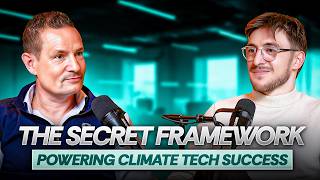
How Climate Startups Get Their FIRST Investor | w/ @prototypecap, Hampus Jakobsson, Jonny Everett
Audio Brief
Show transcript
This episode covers the essentials of securing early-stage funding in climate tech, offering founders actionable advice amidst a shifting venture landscape.
There are four key takeaways from this conversation. First, successful climate tech companies must now demonstrate strong, inherent economic fundamentals, moving beyond reliance on "green premiums" or future policy changes. Second, founders should brand their ventures within specific industry verticals, like energy or deep tech, rather than broadly as "climate tech" to clarify their value proposition. Third, strategic fundraising involves engineering momentum, planning for future rounds, and seeking clear rejections to efficiently manage investor outreach. Finally, the journey of founding a company offers significant asymmetric upside, where the skills and network gained far outweigh the perceived risks of failure.
The venture market has returned to a focus on fundamental economics. Companies that relied on hypothetical policy changes or "green premiums" are struggling, emphasizing the need for robust business models. Founders must ensure their core offering provides inherent value and strong unit economics to attract investment.
The term "climate tech" is increasingly viewed as a broad theme rather than a specific investment vertical. Founders gain clarity and investor interest by aligning their business with established sectors such as energy, industrial materials, or agriculture. This precise framing helps communicate tangible market value and potential.
Fundraising requires proactive management. Founders can engineer momentum by compressing their fundraising timeline and creating a narrative of rapid progress, making the round more competitive. Seeking a definitive "no" from investors is also crucial, saving valuable time and effort by avoiding ambiguous feedback like "come back with more traction."
The startup journey itself offers immense asymmetric upside, even if the venture does not achieve its ultimate goal. The skills developed, the network built, and the experience gained provide significant personal and career growth. People often overestimate the cost of failure and underestimate these profound benefits.
This discussion provides critical guidance for founders navigating the evolving landscape of climate tech investment.
Episode Overview
- The episode deconstructs what it takes to secure a "first check" in climate tech, focusing on the pre-product, conviction-driven stage of investing.
- Expert VCs discuss the shift in the market post-hype cycle, emphasizing the return to fundamental economics and the challenges of a polarized funding landscape.
- The conversation analyzes why the "climate tech" label is becoming problematic, advising founders to brand themselves within specific verticals like energy or deep tech.
- Founders are given direct, actionable advice on fundraising, including how to engineer momentum, seek clear rejections, and understand the asymmetric upside of the startup journey.
Key Concepts
- First Check Investing: The earliest stage of investment, often made with pure conviction in the founders before a product, revenue, or even a company name exists.
- The Ideal Founder Profile: Investors look for founders with high agency who are often polarizing figures, quickly transitioning from needing guidance to driving the process themselves.
- Market Polarization: The current venture market has tightened, with capital concentrating in a few "hot" sectors like AI, raising the bar for companies in other areas.
- Return to Fundamentals: The end of the 2021-2022 hype cycle means companies can no longer rely on "green premiums" or future policy changes; they must have strong, inherent economic models to succeed.
- The "Climate Tech" Label: The term is now viewed as a broad, horizontal theme rather than a specific vertical, and successful companies are branding themselves by their core industry (e.g., energy, materials) to better communicate their value.
- Engineering Fundraising Momentum: Founders can strategically create a sense of urgency and high demand during their fundraising process by compressing the timeline and creating a narrative of rapid progress.
- The Asymmetric Upside of Failure: The experience, network, and skills gained from founding a company provide a massive upside that outweighs the perceived cost of failure, even if the venture does not succeed.
Quotes
- At 24:06 - "The companies that were banking on green premium, policy change, etcetera, etcetera, to make the business work, I mean, they're all dead or they're dying." - Jonny Everets comments on the market shift, noting that startups without inherent economic viability have struggled as the hype cycle has ended.
- At 31:54 - "I think climate is definitely a theme, right, rather than a vertical." - Jonny Everets argues that "climate" is too broad a category for investment and that the focus should be on the specific vertical and business model (e.g., energy, agriculture) first.
- At 55:21 - "If somebody says you should come back with more traction, it means that your innovation or your credentials aren't strong enough." - Andreas Klinger provides a direct translation for one of the most common and vague pieces of feedback VCs give to founders.
- At 1:02:06 - "Also keep in mind you can engineer momentum." - Andreas Klinger points out that founders can strategically create the perception of momentum to make their fundraising round more competitive.
- At 1:05:05 - "People radically overestimate the cost of failure and radically underestimate the potential upside that's possible. And that's even in the case of, quote unquote, failure." - Jonny Everets highlights the immense personal growth and career benefits that come from the startup journey, regardless of the outcome.
Takeaways
- Build a business on strong fundamentals, as the market no longer rewards companies reliant on green premiums or future policy changes.
- Frame your company within a specific industry vertical (e.g., energy, deep tech) rather than using the broad "climate tech" label to clarify your value proposition.
- Proactively manage your fundraising by engineering momentum, strategically planning for future rounds, and seeking a clear "no" from investors to avoid wasting time.
- Recognize that founding a company offers an immense asymmetric upside in skills and network, where the benefits gained far outweigh the perceived risks of failure.