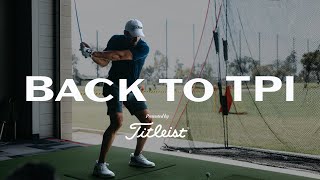
Going Back to Cali: A Visit to TPI

Audio Brief
Show transcript
This episode covers the journey of two amateur golfers through a comprehensive professional club fitting at Titleist, highlighting personalized equipment optimization and essential pre-round mobility.
There are three key takeaways from this episode.
First, implement a dynamic, golf-specific warm-up routine before playing. Simple exercises focusing on ankle, hip, and shoulder mobility using an alignment stick can significantly improve readiness and performance, often proving surprisingly challenging for amateurs.
Second, understand your unique swing tendencies and seek a professional fitting to match your equipment. Specifically, wedges require precise matching to your swing path; shallow swings benefit from less bounce, while steep swings require more, ensuring optimal turf interaction and consistency.
Third, optimize driver performance by focusing on the landing angle, targeting around 38 degrees. This approach maximizes total distance, encompassing both carry and roll. Adjustments to loft, shaft, and head weighting are crucial for controlling launch angle and spin rate to achieve this ideal.
Ultimately, the episode emphasizes how personalized equipment and tailored physical preparation are paramount for maximizing golfing performance.
Episode Overview
- The video documents the experience of two amateur golfers, Eli and Mike, as they undergo a full-bag professional club fitting at the Titleist Performance Institute in California.
- A significant portion of the episode is dedicated to a comprehensive warm-up routine led by a fitness professional, highlighting specific exercises for golf mobility and activation that the golfers find surprisingly challenging.
- The fitting process is shown in detail, covering drivers, fairway woods, irons, wedges, and putters, with expert fitters analyzing swing data to optimize each club for the players' unique swing characteristics.
- The narrative contrasts the two golfers' different swing flaws—one being too shallow ("The Over-Thinker") and the other too steep ("The Under-Turner")—and how the fittings address these specific issues.
Key Concepts
- Golfer-Specific Warm-Up: The video showcases a structured, dynamic warm-up routine using only alignment sticks. The exercises focus on key areas for golfers, including ankle extensions and circles, leg swings, hip hinges, thoracic spine rotations, and shoulder mobility to prepare the body for the golf swing.
- Data-Driven Club Fitting: The fitting process relies heavily on launch monitor data (Trackman) to analyze metrics like ball speed, spin rate, launch angle, and landing angle. The goal is to optimize these numbers for each club, rather than just maximizing distance.
- Swing Tendency and Equipment Matching: The fitters identify specific swing characteristics for each player. Eli's shallow, in-to-out swing path requires wedges with less bounce, while Mike's steep, over-the-top swing benefits from wedges with more bounce. This demonstrates the importance of matching equipment to an individual's swing, not a one-size-fits-all approach.
- Optimizing Launch Conditions: For drivers and fairway woods, a key concept discussed is achieving an optimal landing angle (around 38 degrees) to maximize total distance (carry plus roll). This is achieved by adjusting loft, shaft, and head weighting to control launch angle and spin rate.
- Putter Fitting for Stroke Improvement: The putter fitting segment shows how adjusting the putter's length, lie, and weight can correct setup flaws and improve the putting stroke's path and face angle at impact, leading to more consistent rolls.
Quotes
- At 01:29 - "I feel like I'm bad at this." - Mike comments on his difficulty with a simple ankle circle warm-up, highlighting how foundational mobility exercises can be surprisingly challenging for amateur golfers.
- At 02:29 - "Is this it right here? Like a speed skater?" - Eli humorously describes his posture during a hip rotation exercise, showing the difference between his feel and the correct athletic position.
- At 09:35 - "This is the angle it lands. So, if we can get a ball to land at 38 degrees, that's kind of our target... We're kind of maximizing carry and roll." - Titleist Tour Fitter JJ Van Wezenbeeck explains the importance of optimizing the driver's landing angle to achieve maximum total distance, not just carry.
- At 17:45 - "There's a reason why you're shallow. You're from the inside, contributes to the draw, but you also see it on the wedges... if I give you all the bounce in the world, it's not going to matter. You still have shallow divot patterns." - Vokey Wedge Tour Fitter Aaron Dill explains to Eli that because of his shallow swing, he needs wedges with less bounce to achieve proper turf interaction.
- At 21:17 - "He just came up perfectly square... the final video with his hat down, you couldn't tell me that that wasn't a tour player." - Scotty Cameron Putter Fitter Nick Geyer expresses his surprise at how perfectly Mike's putting stroke improved after getting the correct putter setup.
Takeaways
- Implement a dynamic, golf-specific warm-up routine before playing. Simple exercises focusing on ankle, hip, and shoulder mobility using an alignment stick can significantly improve readiness and performance.
- Understand your personal swing tendencies (e.g., steep vs. shallow) and seek a professional fitting to match your equipment, especially wedges, to your unique swing path for better turf interaction and consistency.
- When evaluating driver performance, focus on optimizing the landing angle (around 38 degrees) to maximize total distance, rather than solely focusing on carry distance or ball speed.