Bing Brunton on Connecting the Connectome to the Body | Mindscape 352
Audio Brief
Show transcript
This episode covers the transition from static brain mapping to embodied neuroscience, exploring how physical bodies and environments fundamentally shape intelligence.
There are three key takeaways. First, structural brain maps are insufficient without accounting for chemical and environmental interactions. Second, intelligence and cognition must be studied within the context of a physical body. Third, researchers are actively using digital twins to simulate how neural circuits drive complex real world behaviors.
Mapping the physical wiring of the brain, known as the connectome, provides only an incomplete picture of biological function. Neurons make up roughly half of the brain, meaning vital support structures like glial cells are often overlooked. Static structural maps also miss critical chemical communication networks and the unique context of receiving cells. Identical electrical signals can trigger vastly different biological responses depending entirely on the specific receiving neuron.
Because of this, the concept of a brain operating in isolated computation is fundamentally flawed. Cognitive systems evolved specifically to control biomechanical bodies interacting with physical environments. Every function we categorize as higher reasoning or consciousness evolved as a sophisticated extension of basic sensory motor control. True intelligence is inherently tied to physical embodiment, proving that the brain does not operate in a vacuum.
To bridge the gap between static wiring diagrams and dynamic physical behavior, scientists are now creating virtual, physics based simulations of entire organisms. These digital twins allow researchers to safely test hypotheses about how neural circuits drive autonomous physical movement. This computational approach reveals hidden biological redundancies, demonstrating that evolutionary pressure builds robust networks rather than pursuing absolute minimalism.
Understanding the true nature of intelligence requires looking beyond static wiring diagrams to see how the brain actively operates within physical reality.
Episode Overview
- Explores the concept of the connectome (the brain's wiring diagram) and why simply mapping neural connections is insufficient for truly understanding brain function and behavior.
- Delves into the critical importance of "embodied neuroscience," arguing that a brain must be studied in the context of the specific biomechanical body it controls and the environment it navigates.
- Discusses the use of computational simulations and "digital twins" of organisms like the fruit fly to test how neural circuits drive complex physical movements.
- Examines how foundational sensory-motor control mechanisms serve as the evolutionary building blocks for higher-order cognition, reasoning, and consciousness.
Key Concepts
- The Connectome and Its Limitations: A connectome maps neural connections, ranging from cellular levels (every neuron) to mesoscale levels (brain areas). However, a structural map alone misses critical extra-synaptic communication, such as chemical gradients, mechanical stretching, and neurotransmitters.
- The Role of Non-Neuronal Cells: Neurons only make up about half of the brain's cells. Glial cells are equally vital to brain function and have their own complex dynamics, showing that a neuron-only view of the brain is fundamentally incomplete.
- Contextual Information Processing: The meaning of a neural signal depends heavily on the identity and context of the receiving cell. Just as human communication varies based on relationships, identical electrical signals can trigger vastly different responses depending on the receiving neuron.
- Central Pattern Generators (CPGs): These are specialized neural circuits capable of producing rhythmic, cyclic motor patterns (like walking or breathing) autonomously, without requiring continuous sensory or central input. They bridge the gap between static wiring diagrams and dynamic physical behavior.
- Embodied Neuroscience: A purely computational, isolated view of the brain is flawed. The brain evolved specifically to control a physical body interacting with a physical environment. Treating the brain as a "brain in a jar" ignores vital biomechanical constraints and realities.
- Digital Twins and Emulation: By building virtual, physics-based simulations of an animal's body and nervous system, researchers can test hypotheses about how neural circuits drive complex movements, overcoming the limitations of studying static biological information.
- Evolutionary Foundations of Cognition: Higher-order cognitive functions, including reasoning and the mechanics of consciousness, likely evolved as sophisticated extensions of the fundamental neural computations originally required for basic sensory-motor control.
Quotes
- At 0:04:40 - "The rough idea is that we all know that the brain is composed of cells because it's an organ like every other organ in your body... And the cells uh work by electrical activity, and they talk to each other through electricity." - Explaining the basic building blocks of brain communication.
- At 0:05:18 - "There's essentially a wiring diagram so to speak of the brain... and that's sort of the connectome roughly speaking is that for for all the cells and their connections and their identities in the brain." - Defining the fundamental concept of the connectome.
- At 0:08:08 - "The rough estimate my my understanding is that half of the cells in your brain are not neurons... they do a lot more than that. um they clearly are involved in all kinds of vital functions and they have their own dynamics." - Highlighting the often-overlooked importance of glial cells in brain function.
- At 0:13:54 - "If you say the same thing to two different people, depending on your relationship with them, they can hear very different messages... depending on the identities of B and C, they could hear very different messages and do very different things with it." - Illustrating how context and cell identity fundamentally alter signal interpretation.
- At 0:15:23 - "The reason that the C. elegans connectivity matrix has been so hard to understand... they do a lot of computation not using that connectivity matrix. So there's a ton of chemical communication." - Explaining the limitations of relying solely on physical wiring maps to understand biological behavior.
- At 0:26:19 - "In contrast, it is some of our current understanding and perhaps hope that the connectivity matrix of the fruit fly, because it's a little bit bigger, it has jointed limbs just like humans do... makes it so that that connectivity matrix is more directly helpful." - Contrasting the structural similarities that might make complex organisms easier to understand neurologically.
- At 0:33:31 - "The generation of these rhythms is not by reflex only, is that your central nervous system, somewhere in your brain and spinal cord... was capable of generating these cycles." - Defining the vital function of Central Pattern Generators in autonomous physical movement.
- At 0:42:31 - "She went off and did it. The answer was three... Three cells. That's the minimum you need." - Revealing the surprising simplicity and redundancy found in biological circuits through computational pruning.
- At 0:46:25 - "It's so obvious to me that the brain does not live in a jar. It always controlled a body, and it always controlled a specific body with these limbs, and these muscles, and these joints." - Emphasizing the core philosophy and necessity of embodied neuroscience.
- At 0:47:49 - "Neurons are some of the most expensive cells to maintain in your body. My hypothesis would be that if a cell is actually not necessary, the body would find a way for it not to be there over a long time frame." - Explaining evolutionary efficiency and challenging the concept of vestigial or useless neurons.
- At 0:52:16 - "We have no examples that we all agree on of agents that are intelligent and conscious except the ones that are embodied." - Pointing out the fundamental link between physical embodiment and higher-order intelligence.
- At 0:52:43 - "Everything that we think of as reasoning, as consciousness... all of that machinery, all of the capabilities for doing so, evolved on top of the neural computations required for sensory-motor control." - Highlighting the evolutionary origins of complex thought as an extension of physical movement.
Takeaways
- Recognize that structural mapping is only the first step in understanding complex systems; you must also account for chemical, mechanical, and environmental interactions.
- Apply the concept of "embodiment" to your understanding of intelligence; recognize that cognitive systems cannot be fully optimized or understood without considering the physical forms they operate within.
- Look for hidden redundancies in biological and organizational systems, as evolutionary pressure builds highly redundant networks for robustness rather than absolute minimalism.
- Utilize "digital twins" and physics-based simulations to safely test complex hypotheses and predict behaviors before applying them to physical reality.
- Acknowledge the critical role of overlooked support structures, like non-neuronal glial cells in the brain, when analyzing how complex systems maintain their overall function and health.
- Remember that the interpretation of a signal depends entirely on the receiver; effective communication requires understanding the context and identity of who is receiving the message.
- Frame higher-level problem solving and cognitive functions as extensions of fundamental interactions with the physical world, rather than entirely abstract processes.
More from Sean Carroll

Mindscape 331 | Solo: Fine-Tuning, God, and the Multiverse

Mindscape Ask Me Anything, Sean Carroll | September 2026
Sep 14, 2026
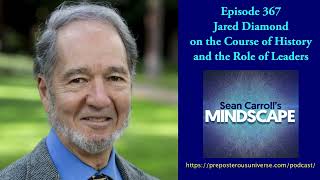
Jared Diamond on the Course of History and the Role of Leaders | Mindscape 367
Sep 07, 2026
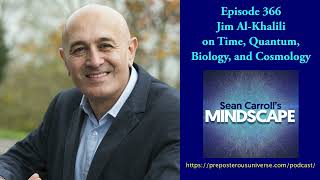
Jim Al-Khalili on Time, Quantum, Biology, and Cosmology | Mindscape 366
Aug 31, 2026