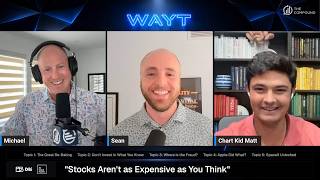
Ask The Compound 208
Audio Brief
Show transcript
This episode explores the critical tension between mathematical optimization and psychological comfort in financial decision-making, while demystifying complex mechanics of retirement planning.
There are four key takeaways from this conversation. First, the debate between lump-sum investing and dollar cost averaging comes down to probability versus regret minimization. Second, the famous four percent rule is often misunderstood as a standard recommendation rather than a worst-case safety net. Third, strategic tax planning requires watching out for marginal tax cliffs. Finally, successful retirement requires solving for time and purpose, not just funding.
Let's look at these in more detail. When deciding how to invest a windfall, the math overwhelmingly favors lump-sum investing. History shows the stock market is up roughly eighty percent of the time over twelve-month periods, meaning holding cash usually results in missed growth. However, dollar cost averaging remains a valid strategy if it prevents an investor from panicking, provided they stick to the schedule regardless of market volatility. The goal is to choose a strategy based on your personal regret profile.
Regarding withdrawal rates, the four percent rule was designed to survive economic catastrophes like the Great Depression. Strictly adhering to it in normal market conditions often leads retirees to drastically underspend, leaving them with significant unintended surplus wealth at the end of their lives. A more flexible approach allows retirees to enjoy the fruits of their labor without fear of running out of money.
On the tax front, the most effective strategy involves filling the bracket. This means converting traditional retirement funds to Roth funds up to the limit of your current tax bracket, such as the twenty-four percent tier, to avoid spilling over into a much higher marginal rate like the thirty-two percent cliff. Additionally, those anticipating a move from a no-income-tax state to a high-tax state should consider executing Roth conversions before relocating to lock in significant geographic arbitrage savings.
The conversation also highlights that the biggest financial hurdle to early retirement is often the healthcare gap before Medicare eligibility. With private insurance premiums averaging nearly twenty-seven thousand dollars annually for families, taking a part-time job specifically for benefits, often called Barista FIRE, becomes a rational mathematical solution. Furthermore, retirement poses an identity crisis. Without a structured plan for how to fill the time void, many retirees struggle with a loss of purpose once the initial honeymoon phase fades.
Ultimately, successful financial independence is about aligning your money with a defined life purpose rather than just hitting a number on a spreadsheet.
Episode Overview
- Explores the tension between mathematical optimization and psychological comfort in financial decisions, specifically comparing lump-sum investing against Dollar Cost Averaging.
- Demystifies complex retirement mechanics, including the "Safe Withdrawal Rate" paradox, strategic Roth conversions, and the massive financial hurdle of the pre-Medicare healthcare gap.
- Critiques the complexity of the US savings system and proposed new account types, advocating for simplicity and flexibility in financial planning.
- Discusses the often-overlooked identity crisis of retirement, emphasizing that successful planning requires solving for time and purpose, not just money.
Key Concepts
- The Withdrawal Rate Reality: The 4% rule is not a standard recommendation but a "worst-case scenario" safety net built for economic catastrophes like the Great Depression. Adhering to it strictly in normal markets often leads to retirees underspending and dying with unintended surplus wealth.
- Lump Sum vs. DCA: There is a fundamental conflict between probability and psychology. Mathematically, lump-sum investing wins because the market is up ~80% of the time over 12-month periods. However, Dollar Cost Averaging (DCA) is a valid strategy if it minimizes regret and prevents an investor from panicking, provided they adhere strictly to the schedule regardless of volatility.
- Strategic Tax Bracket Arbitrage: Effective tax planning involves "filling the bracket." This means converting traditional retirement funds to Roth funds up to the limit of your current tax bracket (e.g., the 24% bracket) to avoid spilling over into a much higher marginal rate (the 32% cliff).
- Geographic Arbitrage: For those anticipating a move (especially military personnel), performing Roth conversions while residing in a state with no income tax before moving to a high-tax state (like California or New York) can yield massive lifetime savings.
- The Healthcare Bridge: The single biggest financial barrier to early retirement (retiring before 65) is bridging the gap between employer coverage and Medicare. With private insurance costing upwards of $25,000/year for families, "Barista FIRE" (working a part-time job specifically for benefits) becomes a mathematical and psychological solution.
- Retirement Identity Crisis: Modern retirement creates a "time void." Successful retirees transition to a new role (consulting, volunteering) rather than just away from work. Without a "job description" for retirement, many suffer from a loss of purpose after the initial honeymoon phase.
Quotes
- At 2:45 - "It's meant to protect you against the ultimate worst-case number... That's why I think it's far too conservative because most of the time you end up with way more money and don't spend enough of your nest egg." - Context: Explaining why the 4% rule often leads to underspending in retirement.
- At 6:38 - "Since 1928, the US stock market is up 73% of all years... 80% of the time over 12-month periods, the stock market is up... So most of the time putting your money into the market, it's going to be higher in 12 months." - Context: Highlight the statistical dominance of lump-sum investing over waiting.
- At 8:35 - "Create a plan and stick with it come hell or high water... Don't make changes because you wish you would have done something else... This is the plan we set without knowing what was going to happen in the future." - Context: Defining the critical success condition for Dollar Cost Averaging.
- At 15:21 - "If Phil is going to return back to California, New York, or another high income tax state like New Jersey, I would really strongly consider a conversion." - Context: Identifying the "geographic arbitrage" window to pay federal tax now to avoid state tax later.
- At 25:35 - "The cost of health insurance, gentlemen, is just way too damn high. Like we are looking at $27,000 the average premium for a health insurance plan across the United States." - Context: Illustrating the massive financial barrier preventing early retirement for many families.
- At 30:04 - "I don't think sitting around... scrolling through Twitter or watching our show on YouTube is a great way to participate in society. I think you have to go out and figure that out." - Context: A warning that passive consumption is not a substitute for active engagement and purpose in retirement.
Takeaways
- Execute the "Fill the Bracket" Strategy: Review your current income against federal tax tables. If you are in the 22% or 24% bracket, calculate exactly how much room you have before hitting the 32% jump, and use that space for Roth conversions or capital gains harvesting.
- Choose Your Regret Profile: When investing a windfall, decide immediately if you are optimizing for math (Lump Sum) or sleep (DCA). If you choose DCA, automate the schedule immediately to remove the temptation to "time" the market based on news or emotions.
- Solve the "Time" Equation Before Quitting: Do not retire without a structured plan for your daily life. Whether it is a "Barista FIRE" job for health insurance or a dedicated volunteering role, having a schedule is as vital to your retirement survival as your savings account.