Are AI's Economics Unsustainable? — With Ed Zitron

Audio Brief
Show transcript
This episode dissects the financial viability of the generative AI industry, questioning its sustainability amidst massive valuations and uncertain paths to profitability.
Key takeaways from this discussion include the industry's fragile financial foundation, the need to critically evaluate AI progress beyond narrow benchmarks, the deep link between AI's economic success and job automation, and the weakness of current consumer AI business models.
The current AI boom's financial foundation appears extremely fragile. It relies on a chain of belief from investors to AI companies to GPU manufacturers like NVIDIA, creating a potential single point of failure for the broader market. This dynamic fuels a mass delusion, where massive cash burn and capital expenditures far outweigh realistic revenue streams.
Investors and users must scrutinize claims of AI progress. A critical distinction exists between improvements on narrow, often "gamed" benchmarks and the development of new, reliable, real-world capabilities. Incremental advancements do not necessarily equate to new functionalities that justify trillion-dollar valuations.
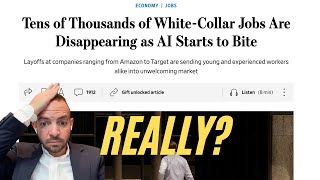
The economic success of the AI industry is deeply intertwined with the controversial goal of automating jobs. For current valuations to be justified, the technology must replace expensive full-time employees, serving as a primary driver of both investment and public anxiety. This underlying imperative is often unspoken but crucial.
Despite the pervasive hype, the consumer business models for leading AI companies seem weak. This is evidenced by extremely low conversion rates from free to paid users, undermining their high valuations. The value proposition for the average user, particularly in terms of willingness to pay, remains unproven.
This analysis suggests the generative AI industry may be an unsustainable bubble built on hype rather than sound economics and proven capabilities.
Episode Overview
- This episode features a critical debate on the financial viability of the generative AI industry, with tech critic Ed Zitron arguing it's an unsustainable bubble built on hype and flawed economics.
- The conversation dissects the massive disconnect between the industry's trillion-dollar valuations and its comparatively minuscule actual revenue, questioning the path to profitability for major players like OpenAI.
- The discussion explores the limits of current AI capabilities, arguing that incremental improvements on benchmarks do not equate to the new, reliable functionalities needed to justify the investment.
- The episode also examines the broader economic implications, including the stock market's dependence on the AI boom and the growing public skepticism fueled by the tech industry's focus on labor replacement.
Key Concepts
- Financial Unsustainability: The core argument that the generative AI industry's business model is fundamentally broken, characterized by massive cash burn and capital expenditures that far outweigh any realistic revenue streams.
- Mass Delusion and Bubble Mentality: The idea that the industry is caught in a hype-driven speculative bubble, where valuations are disconnected from profitability, user metrics, or real-world capabilities.
- Capability vs. Benchmarks: A distinction is made between AI models improving on specific, often "gamed" benchmarks and their ability to perform new, reliable, multi-step tasks in the real world.
- Labor Replacement as an Economic Driver: The unspoken imperative that for AI company valuations to be justified, their technology must ultimately replace the work of expensive full-time employees.
- Market Dependence on NVIDIA: The significant risk posed to the broader stock market, which is heavily propped up by NVIDIA's performance, a company whose success is almost entirely dependent on continued massive spending by the unproven AI sector.
- Flawed User Metrics: The business models of leading AI companies are scrutinized, revealing weaknesses such as extremely low conversion rates from free to paid users, which undermines their valuation.
Quotes
- At 27:14 - "Better does not mean more capabilities... it does not mean that these models now can do a new thing." - Ed Zitron arguing that improvements on benchmarks do not equate to the emergence of genuinely new and reliable functionalities.
- At 34:33 - "I think the thing that's been unspoken so far is that when it comes to the valuations for a lot of these companies, they're going to need to... replace full-time employees... in order to be successful." - Alex Kantrowitz highlighting the economic imperative behind the AI push, linking massive valuations to the need for labor replacement to achieve profitability.
- At 46:07 - "For OpenAI, they've estimated... $126 billion of revenue a year by 2029... just to be clear, Netflix made about $39 billion in subscriptions last year, and Spotify made $16 billion. So you're telling me that whatever this market is, is gonna be bigger than both of those, doubled?" - Ed Zitron using a comparison to major subscription services to illustrate how absurd he finds the revenue projections for AI companies.
- At 57:55 - "That's a dog's dookie of a conversion rate. That is so bad." - Ed Zitron, after calculating OpenAI's poor conversion rate from its vast number of monthly active users to its relatively few paying customers.
- At 59:22 - "We are in a moment of mass delusion, where no one really wants to talk about these numbers because when you talk about them, they're scary." - Ed Zitron, summarizing his view of the financial state of the generative AI industry.
Takeaways
- The financial foundation of the current AI boom is extremely fragile, relying on a chain of belief from investors to AI companies to GPU manufacturers, creating a single point of failure for the market.
- Scrutinize claims of AI progress by distinguishing between improvements on narrow benchmarks and the development of new, reliable real-world capabilities.
- The economic success of the AI industry is deeply intertwined with the controversial goal of automating jobs, which is a primary driver of both investment and public anxiety.
- Despite the hype, the consumer business models for AI seem weak, as evidenced by poor conversion rates, suggesting the value proposition for the average user is not yet proven.